
Everything in the Water
Uber and the ADA, the Strait of Hormuz, internet architecture, Army Corps permits, and Australia—five reports from April 10, 2026.

Five reports from April 10. The Strait of Hormuz piece is the one I’d start with if you only have time for one today—it’s genuinely alarming in a way that hasn’t fully broken through the news cycle, and CRS is doing what it does best: cataloging exactly what’s at stake before anyone else has organized the picture. The ADA ridesharing piece is the most immediately relatable. The internet architecture report is the longest and most technical, but it’s also the kind of foundational briefing paper that makes later policy debates legible—worth bookmarking even if you don’t read it all at once. I’m covering all five.
For the data nerds: I initially ran into errors on all the April 10 materials—”We couldn’t find that page, try searching above or one of the suggestions below.” A few minutes later, I could access all but two: the Hormuz Report and the Army Corps Works In Focus, both of which continued to return errors until they magically reappeared after repeated attempts while doing other tasks. This is why we champion LOCKSS! If you’re unfamiliar with EveryCRSReport.com, they serve as an independent repository of CRS Reports and offer epub versions as well—they were my backup plan until the official pages finally loaded. It’s also entirely possible I bring some of these errors on myself. I tend to be faster than the average browser and face extra captchas online because of it. I am presumed to be a slow bot.
CRS REPORT: The Strait of Hormuz—What’s Stuck Besides Oil
While this is technically version 3 of this report, all three versions are marked uploaded April 10 with the only difference between each version being the version number on the last page. Effectively, this is a new Report.
Title: The Strait of Hormuz in Brief: Non-Oil Shipments and Effects on U.S. Shippers
Report No. R48903 | Type: Report | Date: April 10, 2026, Version 3 | CRS Author(s): John Frittelli, Specialist in Transportation Policy; Ben Goldman, Analyst in Transportation Policy | Official Congress.gov copy | WCSBR GitHub copy | Internet Archive copy
Key Terms and Concepts
Strait of Hormuz — the narrow waterway between the Persian Gulf and the Gulf of Oman through which roughly 20% of the world’s traded oil passes, along with significant volumes of other goods. Under long-established international law, it has been an open waterway; since February 28, 2026, Iran has asserted control over it.
Jones Act — Section 27 of the Merchant Marine Act of 1920, which requires that cargo transported between U.S. ports travel on vessels that are U.S.-built, U.S.-owned, and U.S.-crewed. A presidential waiver can temporarily relax these requirements.
Maritime Security Program (MSP) — a federal program administered by the U.S. Maritime Administration (MARAD) that pays annual stipends to owners of privately held, commercially operated U.S.-flagged cargo ships in exchange for their availability to the Department of Defense during wartime or national emergency.
Tanker Security Program (TSP) — a similar MARAD program specifically for U.S.-flagged tankers engaged in foreign commerce.
Dry bulk ships — vessels that carry unpackaged bulk commodities such as grain, coal, or minerals in their holds.
Jones Act waiver — a presidential authorization permitting foreign-flagged vessels to carry goods between U.S. ports, bypassing Jones Act restrictions, typically issued during emergencies when the domestic fleet is insufficient.
Synopsis
Before U.S. and Israeli military operations began against Iran on February 28, 2026, roughly 130 ships transited the Strait of Hormuz daily. As of April 7, 2026—the report’s effective date—only a handful of ships were transiting each day. Iran has asserted control over the Strait, with the Islamic Revolutionary Guard Corps reportedly charging tolls and redrawing shipping lanes closer to its coastline under an unsubstantiated claim that harbor mines occupy the normal lanes. The U.K. Maritime Trade Operations centre had recorded 17 attacks on vessels since March 1, with crew members killed or seriously injured. An estimated 1,000 ships were holding outside or inside the Strait: 800 in the Persian Gulf waiting to transit eastbound, 200 outside waiting to go westbound. A two-week ceasefire announced April 7 does not appear to require Iran to relinquish control.
The report focuses specifically on what’s at stake beyond oil.
Food and animal feed are the most immediately human-stakes category. Persian Gulf nations rely heavily on ships for imported food—air freight is economical only for products with exceptionally high value-to-weight ratios, which generally do not include foods. Roughly 280 dry bulk ships carrying grain—corn, rice, soybeans, wheat—were trapped when the report was written. The United States is the top supplier of soybeans to the region, with New Orleans, Portland, San Francisco, Houston, and Norfolk as the leading export ports. The United States also supplies frozen chicken (through the Port of Savannah, which sends roughly 10% of its frozen chicken exports to Persian Gulf nations), fruits and nuts, dairy, forage products for animal feed, and condiments. Persian Gulf nations account for nearly 20% of U.S. exports by ship of condiments and sauces. Some Gulf nations have built large storage facilities in anticipation of exactly this kind of disruption.
Aluminum and steel are major industrial stakes. Persian Gulf aluminum plants rely on imported alumina (the raw material), and the region produces about 8% of the world’s aluminum—including roughly 40% of U.S. waterborne aluminum imports. New York and Houston import nearly all their ship-borne aluminum from the Gulf; Baltimore imports close to half. Steel from the region is a smaller share of U.S. imports, but flat-rolled steel and steel beams from the Gulf may be affected. UAE and Saudi Arabia together supply about 16% of cement imported at Houston and Savannah.
Automobiles flow through the Strait both ways. The UAE is a major import distribution hub for passenger cars. In 2025, Persian Gulf countries accounted for over 20% of U.S. waterborne exports of passenger cars and 15% of trucks, shipped from New York, Savannah, and Houston.
Oil and gas byproducts carry their own strategic weight. Qatar produces about 30% of the world’s helium as a byproduct of natural gas processing. Helium is not a luxury input: it is essential to semiconductor manufacturing (used to cool and purify chip fabrication environments), MRI machines, fiber optic production, and a wide range of scientific research applications. It cannot easily be synthesized or substituted, and once released into the atmosphere it is gone. Helium supply disruptions have real consequences for medical imaging capacity and the chip supply chains that everything from cars to defense systems depends on. Charleston, SC relies on paraxylene (a plastics feedstock) for roughly half its waterborne imports, sourced from Saudi Arabia. The Strait carries about one-third of the world’s seaborne trade in fertilizer inputs, including ammonia and urea; Persian Gulf countries account for nearly 40% of U.S. waterborne urea imports.
The [Second Trump Administration] issued a 60-day Jones Act waiver on March 17, 2026, through May 17, allowing foreign-flagged vessels to carry products normally exported through the Strait—petroleum, fertilizers, and others—between U.S. ports. This opens the much larger global fleet to domestic coastal shipping and may dampen some price effects.
On U.S.-flagged vessels in the region: as of January 2026, 60 ships were enrolled in the MSP and 9 in the TSP. Five of these—vehicle carrier Alliance Fairfax, container ships APL Eagle and Maersk Yorktown in the MSP, and tankers CS Anthem and Stena Imperative in the TSP—were in the Persian Gulf in February 2026 and had not departed as of April 1. A prolonged Strait closure could reduce the effectiveness of these national security fleet programs if enrolled vessels cannot carry out defense obligations.
Commentary
Before getting to the substance: this report is exceptionally well-sourced. The commodity-level trade data—which ports export soybeans, what share of Houston’s cement comes from the Gulf, where Charleston’s paraxylene originates—comes from U.S. Census Bureau USA Trade Online port-level data, synthesized across dozens of specific commodity codes. That kind of granular sourcing is exactly what makes CRS indispensable, and it’s worth naming.
What this report does well is refuse to let oil dominate the frame. The Strait of Hormuz conversation almost always collapses into oil prices within two sentences. CRS is doing something more useful here: building the full invoice. Helium for semiconductor fabs. Urea for farmers. Soybeans for the Gulf’s flour mills. Frozen chicken from Savannah. These are not marginal concerns—they are the supply chains that underpin both U.S. agricultural export markets and Gulf food security simultaneously.
The Jones Act waiver is worth some time. The Jones Act is one of the more persistently contested pieces of American maritime law—first enacted in 1920, it has survived repeated challenges and repeal efforts for over a century. Its proponents argue that it sustains a domestic shipbuilding and crewing capacity essential to national defense; its critics argue that it inflates the cost of domestic coastal shipping significantly, effectively functioning as a hidden tax on island economies like Hawaii and Puerto Rico and on domestic energy transport. The law substantially restricts the availability and price of domestic coastal shipping—there are only so many U.S.-built, U.S.-crewed vessels, and that scarcity has costs. The [Second Trump Administration] issuing a waiver signals that the economic pressure from the Strait disruption is real enough to override Jones Act politics, at least temporarily. That 60-day window expires May 17.
The five stranded U.S.-flagged vessels are worth flagging not just as a human interest story (though American crews stuck in the Persian Gulf is genuinely that) but as a structural vulnerability. The MSP and TSP exist precisely to maintain a ready fleet for national emergencies—and there are five enrolled vessels that cannot move. The TSP enrollment shortfall (designed for up to 20 ships; currently at 9, now with two unable to transit) is a quiet data point with real implications.
The situation on the ground is moving faster than a CRS update cycle, though admittedly not by much—and I’m inherently slower still. Treat any specific numbers—ships in holding, attack counts—as snapshots, not current status. It feels surreal: we’re watching a deadly war unfold in real time that could, among its many other consequences, produce a condiment shortage just in time for the nation’s 250th birthday celebration. Support the war effort—eat your hot dogs plain.
Further Reading: Strait of Hormuz
UNCTAD: Strait of Hormuz Disruptions—Implications for Global Trade and Development (March 2026)
U.K. Maritime Trade Operations Centre — recent incident reports
U.S. Maritime Administration (MARAD): United States-Flag Privately-Owned Merchant Fleet Report
CRS Report: Iran Conflict and the Strait of Hormuz: Impacts on Oil, Gas, and Other Commodities (R45281)
CRS Report: U.S. Maritime Administration (MARAD) Shipping and Shipbuilding Support Programs (R46654)
CRS LEGAL SIDEBAR: When Your Ride Leaves You Behind
A new product type for this publication. CRS Legal Sidebars are attorney-authored, event-driven legal analyses prepared for Congress. They run longer than an Insight—typically four to seven pages—and go deeper into case law and statutory interpretation. This one is fresh: the DOJ’s lawsuit against Uber was filed in September 2025, the district court denied Uber’s motion to dismiss on March 5, 2026, and this Sidebar appeared five weeks later.
Title: Applying the Americans with Disabilities Act to Ridesharing Companies
Report No. LSB11417 | Type: Legal Sidebar | Date: April 10, 2026, Version 1 | CRS Author(s): April J. Anderson, Legislative Attorney; Abigail A. Graber, Legislative Attorney | Official Congress.gov copy | WCSBR GitHub copy | Internet Archive copy
Key Terms and Concepts
ADA Title III — the section of the Americans with Disabilities Act that prohibits disability discrimination by public accommodations and certain transportation operators, and requires reasonable modifications for people with disabilities.
Specified public transportation — a term of art under Title III referring to transportation by non-aircraft vehicles that provides general or special service to the public on a regular and continuing basis. Courts have largely held that ridesharing companies qualify.
Wheelchair-accessible vehicle (WAV) — a vehicle modified to accommodate passengers who use wheelchairs.
Reasonable modification — the ADA’s standard for what covered entities must do to accommodate people with disabilities; modifications are not required if they would “fundamentally alter” the entity’s services.
Stowable mobility aid — a foldable wheelchair, walker, or similar device that can be collapsed and stored in a standard vehicle without modification.
Synopsis
Title III of the ADA prohibits disability discrimination by entities “primarily engaged in the business of transporting people”—and courts have repeatedly held that Uber and Lyft meet that standard, rejecting the companies’ argument that they are technology platforms rather than transportation providers. Whether they are also “places of public accommodation” is more contested and courts have split, but the practical stakes are the same either way: both provisions carry identical substantive requirements.
What the ADA requires of ridesharing companies includes: not denying service or providing unequal service to people with disabilities; making reasonable modifications to policies when needed; not imposing unnecessary eligibility criteria that screen out disabled riders; transporting riders with service animals and stowing mobility aids; and not charging additional fees for reasonable accommodations.
What it does not require: any company to purchase accessible vehicles.
The Sidebar walks through three major areas of litigation:
Wheelchair-accessible vehicles (WAVs). Uber and Lyft offer WAV services in limited jurisdictions—generally where local regulations or financial incentives made it worth their while. Plaintiffs in cities without WAV access have sued, arguing the companies could modify their practices. Courts accepted these claims as plausible at the pleadings stage, but plaintiffs have lost at trial in all three cases CRS identified. The courts found that plaintiffs failed to show a reasonable, concrete way to require expanded WAV service—not just an “iterative process” of trial and error—and that the low supply of WAV-interested drivers, not company policy, was the operative barrier.
Service animals. Uber and Lyft both have policies requiring drivers to accept passengers with service animals. Despite this, the National Federation of the Blind sued Uber in 2014 over routine driver denials, cancellation fees charged to refused passengers, and harassment. A 2016 settlement required Uber to use pop-up notifications reminding drivers of their obligations, terminate drivers who knowingly refused service-animal riders, and facilitate complaint reporting. A monitoring period expired in 2020; the court declined to extend it, finding Uber in “substantial compliance”—having reduced discriminatory incidents, albeit the Sidebar notes “only slightly.”
Stowable mobility aids and wait-time fees. The DOJ settled with Lyft in 2020 over drivers refusing to assist passengers with foldable wheelchairs and walkers. Lyft now requires drivers to stow these devices and assist unless physically unable to. In 2021, the DOJ settled with Uber over wait-time fees charged to disabled riders who needed more time to board; the settlement provided several million dollars in compensation to more than 65,000 Uber users and established an online certification process for riders who need more boarding time.
The latest action: the DOJ sued Uber in September 2025, alleging ongoing violations including drivers mistreating visibly disabled riders, refusing service-animal passengers (and directing them to the higher-priced Uber Pet), failing to train and discipline drivers, and charging cancellation fees without consistent redress. The district court denied Uber’s motion to dismiss on March 5, 2026, rejecting Uber’s technology-company defense. The litigation is ongoing.
Commentary
Something about the “we’re just a software platform” defense should bother you, because it should. Ridesharing companies have repeatedly argued—including in this litigation—that they are not transportation companies but technology companies: they develop and license software that connects independent drivers to riders, and whatever happens in those rides is not their responsibility. As a consumer, I find this mildly alarming; as a lawyer, I have never been a fan. The software was purpose-built to connect drivers and riders for transportation. The companies set the prices, define the service areas, establish driver standards, and control what types of vehicles are permitted on the platform. That’s not software; that’s business control. Uber and Lyft devastated traditional cab markets precisely because they could coordinate and scale what taxis couldn’t—not because they wrote elegant code. The fact that this argument keeps getting raised, despite recurring losses, suggests it’s less a genuine legal theory and more a litigation strategy designed to delay and exhaust plaintiffs.
The WAV litigation record is striking and somewhat counterintuitive. People with disabilities have largely won the legal argument—ridesharing companies are transportation companies, covered by the ADA—but largely lost the practical battle. At trial, courts have consistently found that plaintiffs couldn’t identify a concrete, workable proposal to actually expand wheelchair-accessible service. The ADA’s “reasonable modification” standard requires specificity, and “figure it out” doesn’t qualify.
This is a real structural problem. The ADA was written for a world where a covered entity controls its own fleet, facilities, and labor. Ridesharing companies operate through a gig-driver model where no one owns the cars and drivers self-select into the platform. WAVs are expensive and require specialized licensing in some jurisdictions; very few drivers choose to operate them unless financially incentivized. The law reaches Uber and Lyft, but the modifications the law can compel may not actually change the on-the-ground experience of a wheelchair user trying to get a ride.
The service-animal litigation tells a different story—there the legal mechanism fits the problem better. Uber can require drivers to accept service animals as a condition of platform access, can train and discipline for noncompliance, and has done so under legal pressure. The remaining gap is enforcement and monitoring, not structural impossibility.
Congress has options here that the courts don’t. The Sidebar notes that localities have used financial incentives and local regulations to get ridesharing companies to expand WAV service in ways that litigation couldn’t compel. Congress could mandate similar approaches or establish different standards for the trial-and-error question that has been the courtroom stumbling block. The DOJ lawsuit is still live and may produce additional legal precedent—or another settlement.
It strikes me, as a side note, that someone interested in building an ethically operated, WAV-accessible passenger transportation business or non-profit could find more demand than supply. Municipal paratransit frequently falls short of need; a purpose-built, mission-driven organization could help fill a genuine gap. That’s not a policy recommendation—just a thought I couldn’t quite let go of.
Note: The DOJ case against Uber is ongoing as of this writing. Verify current case status before relying on this Sidebar for legal research purposes.
Further Reading: ADA and Ridesharing
DOJ: United States v. Uber Technologies, Inc. — case information
U.S. Access Board: Guides to the ADA Guidelines for Transportation Vehicles
Note: The DOJ case against Uber is ongoing as of this writing. Verify current case status before relying on this Sidebar for legal research purposes.
The ADA ridesharing piece connects to something worth naming explicitly: the gap between legal coverage and practical access. A court can say Uber is a transportation company bound by the ADA. It cannot actually put wheelchair-accessible vehicles on the road. That gap is exactly the kind of problem that requires legislative attention rather than litigation—which is presumably why CRS is writing about it.
CRS REPORT: The Internet Has a Blueprint
Brand new—this is version 1. At 23 pages, this is the longest report in today’s batch. It is also the most foundational: this report won’t be obsolete next week, and it’s the kind of document that makes later, faster-moving policy debates easier to follow. If you have an interest in tech policy, AI regulation, broadband, or cybersecurity—it’s worth the time.
I’ll be direct: this is one of the best explanations of how the internet works that I can recall having read. It is not a simple introduction—it is detailed, nuanced, and grounded in the actual architecture that network engineers use to think about problems. If you are teaching about the internet, cloud computing, AI training, or competitiveness policy, this report should probably be required reading.
Title: Internet Architecture: A Layer-Based Analysis of Selected Internet Policy Issues
Report No. R48902 | Type: Report | Date: April 10, 2026, Version 1 | CRS Author(s): Ling Zhu, Specialist in Science and Technology Policy | Official Congress.gov copy | WCSBR GitHub copy | Internet Archive copy
Key Terms and Concepts
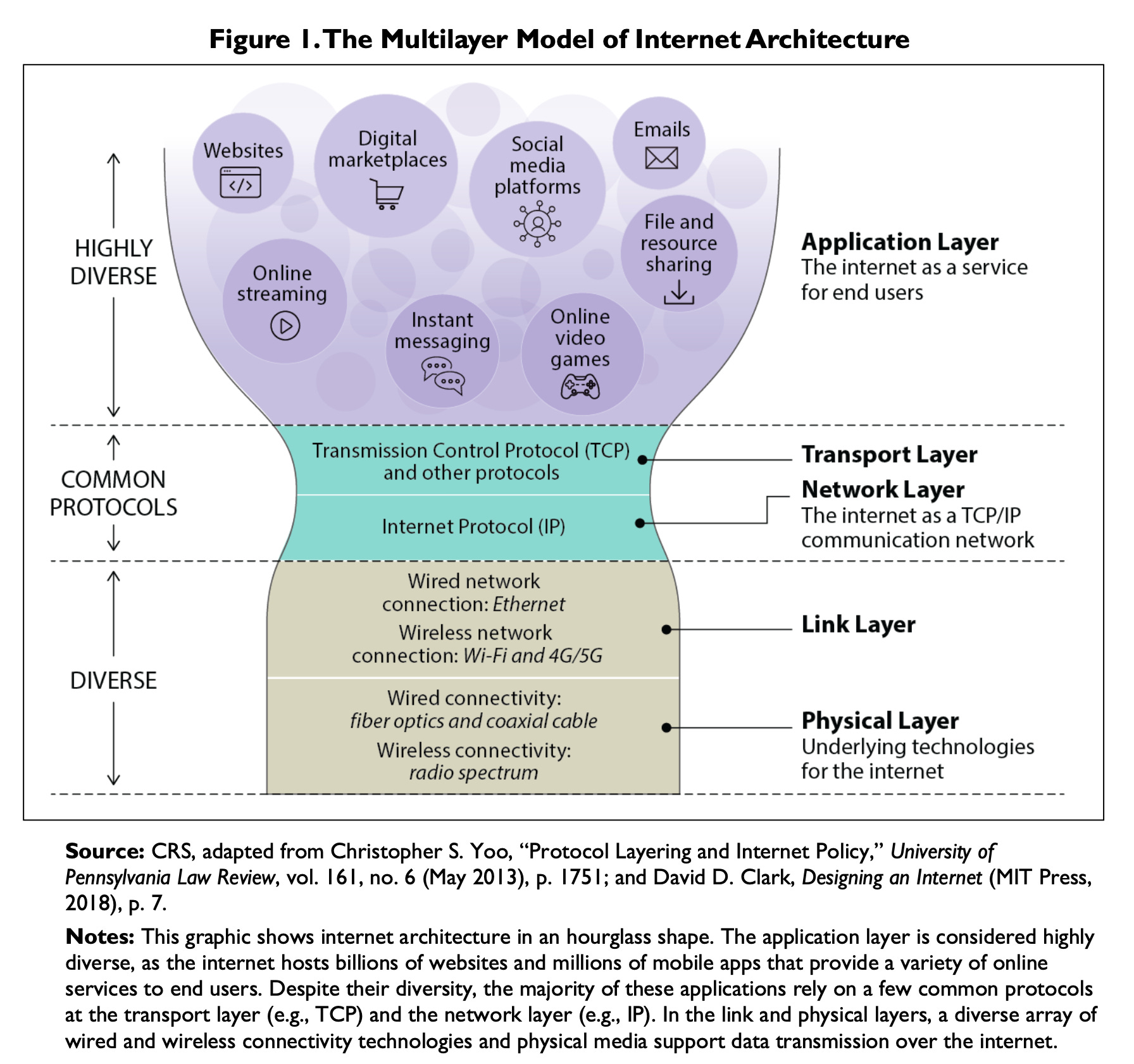
Internet architecture — the fundamental design of the internet: a set of technical principles, protocols, and network structure that collectively governs how the internet works. It has remained largely unchanged for decades.
Application layer — the top layer, where end users interact with the internet: websites, email, social media, streaming services, online marketplaces.
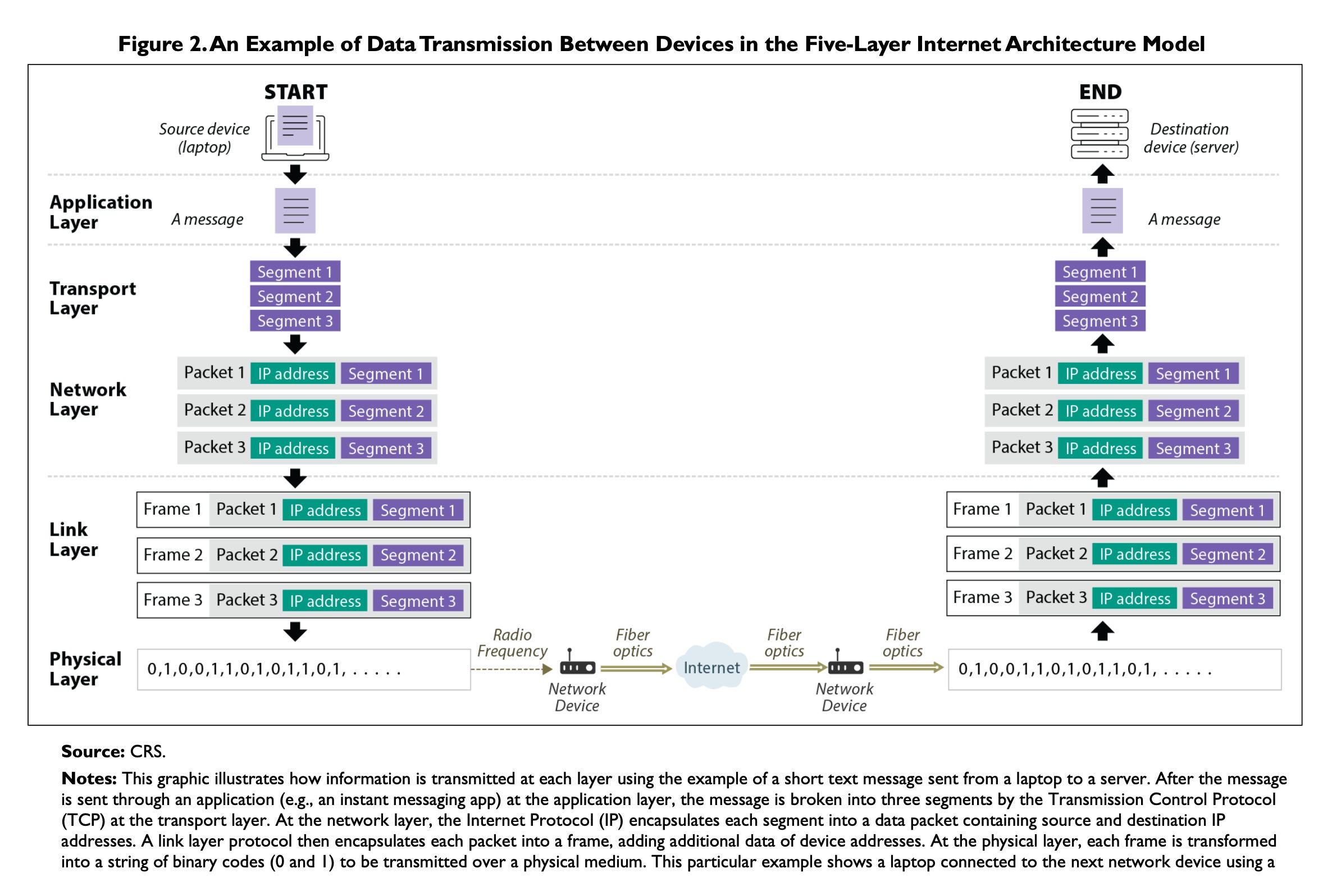
Transport layer — responsible for moving data generated by applications between devices. The primary protocol here is the Transmission Control Protocol (TCP), which ensures reliable, ordered, error-free data transmission.
Network layer — finds the most efficient path to route data across interconnected networks using Internet Protocol (IP) addresses. Because the internet runs on both TCP and IP, it is also called a “TCP/IP network.”
Link layer — moves data packets between neighboring devices within a network via wired (Ethernet) or wireless (Wi-Fi, 4G/5G) connections.
Physical layer — the actual transmission media: fiber-optic and coaxial cables for wired connections, radio spectrum for wireless.
Cloud computing — an internet-based service model in which users remotely access shared computational resources (processing, storage, software, networking) without owning or managing the underlying infrastructure. Three main models: Software as a Service (SaaS), Platform as a Service (PaaS), and Infrastructure as a Service (IaaS).
Hyperscalers / Cloud service providers (CSPs) — large-scale providers of cloud computing services. The market is highly concentrated: Amazon Web Services (AWS), Microsoft Azure, and Google Cloud together held over 60% of worldwide cloud market share in the last quarter of 2025.
Domain Name System (DNS) — the internet’s “address book,” translating human-readable domain names (like gpo.gov) into numeric IP addresses that computers use to route traffic.
IETF (Internet Engineering Task Force) — the primary nongovernmental, multistakeholder body that develops and maintains voluntary technical standards for the internet, including TCP and IP.
ITU (International Telecommunication Union) — the United Nations’ specialized agency for information and communications technology, with 194 member states. The IETF and ITU have been in tension over who sets internet standards.
New IP — a proposal submitted by the Chinese company Huawei to an ITU advisory group in 2019, calling for new network protocols that would restructure how the internet routes and controls data. Critics raised concerns about centralized state control features built into the design.
BEAD Program — Broadband Equity, Access, and Deployment Program, established by the Infrastructure Investment and Jobs Act with $42.45 billion appropriated to fund broadband infrastructure in all 50 states and territories.
Geo-blocking — restricting access to internet services based on a user’s geographic location (approximated from IP address).
Synopsis
The internet’s core architecture has not changed since its foundational design by U.S.-based researchers in the 1970s and 1980s. What has changed is everything running on top of it. This report introduces the five-layer model as a practical analytical tool for Congress, then applies it to three policy domains: unlawful online content, broadband deployment, and cloud computing for AI.
The report includes a full Summary at the front; all of that amazing technical explanation to help you understand the history and state of the Internet and artificial intelligence. The following treatment focuses on the policy dimensions most likely to be actionable for Congress.
The five-layer model as a policy lens. The value of the framework is that it maps intervention options to the level where they would actually operate. To address illegal content online, for instance, policymakers could act at different layers simultaneously: seizing a website at the application layer; using deep packet inspection at the transport layer to detect and block infringing material; notifying domain registries at the network layer; or implementing signal jamming (as federal agencies may do in prisons) at the link/physical layer. The choice of layer determines what’s technically feasible, who bears the burden, and what the collateral effects are—and getting that wrong is a major source of bad internet policy.
DNS governance and unlawful content. The DNS is governed not by any government but by ICANN, a California nonprofit, following a decade-long transfer from U.S. Department of Commerce oversight completed in January 2017. ICANN itself has no authority to block websites—that power lies with registry operators (the entities that manage top-level domains like .com and .gov). The report notes that federal agencies have pursued website seizures and voluntary programs to curb opioid sales, copyright infringement, nonconsensual intimate images, and foreign cyber activity—but the private-sector governance structure makes direct federal regulation at the DNS level difficult. The 119th Congress is considering H.R. 791, which would authorize U.S. district courts to issue blocking orders to domain name resolution service providers for certain foreign copyright-infringing sites.
Broadband at the link/physical layer. Congress appropriated $42.45 billion for the BEAD Program in the IIJA. The report notes ongoing debate over which physical-layer technologies can meet BEAD’s performance requirements: fiber (highest speeds, high deployment cost), low earth orbit satellites (new to market, weather-sensitive, works in remote areas), and fixed wireless (effective for clustered households, limited in rural or obstructed terrain). Current NTIA guidelines take a technology-neutral approach, allowing states to choose from any technology meeting the statutory performance thresholds.
Cloud computing and AI. This is where the report’s contemporary policy urgency is sharpest. Cloud computing is now central to AI development—datasets are stored on cloud servers, models are trained there, applications are deployed from there. The market is highly concentrated: in 2025, AWS had been used by over 50% of professional AI developers surveyed, Microsoft Azure by 28%, and Google Cloud by 24%. Total enterprise cloud spending in 2025 was estimated at $419 billion, a 30% increase from 2024, driven largely by AI demand. Estimated training costs for leading AI models ranged from $41 million to $170 million in 2024. The FTC’s January 2025 staff report on cloud-AI partnerships flagged three antitrust concerns: CSPs limiting computational access to non-partner AI developers; contractual lock-in making it difficult for AI developers to switch providers; and CSP access to sensitive AI developer information.
Safeguarding AI cloud services from foreign adversaries. Since October 2022, the Commerce Department’s Bureau of Industry and Security (BIS) has issued export control rules limiting Chinese access to advanced AI chips. The report describes a recognized gap: the rules restrict physical access to chips, but foreign entities—including Chinese AI developers—have reportedly rented the same chips remotely through U.S.-based cloud platforms. The 119th Congress is considering several bills to close this gap. The Remote Access Security Act (H.R. 2683 / S. 3519) would extend export controls to cover remote access to controlled technology. The Full AI Stack Export Promotion Act (H.R. 6996) would make it U.S. policy to ensure global AI deployment runs on U.S. models, U.S. cloud operators, and U.S.-designed chips.
Enforcement challenges are significant at every layer. At the application layer, foreign entities could access services through subsidiaries, shell firms, or brokers paying with cryptocurrency. At the TCP/IP layer, zero-knowledge encryption makes it technically infeasible for CSPs to monitor whether cloud usage is malicious. At the physical layer, cutting off backbone connections would impose a blanket block on entire countries, not targeted foreign actors.
Commentary
The report is designed to be a reference document—a primer that a congressional staffer or policymaker can pick up before a markup and use to make sense of technical arguments they’d otherwise have to take on faith. CRS has produced something incredibly useful here, because the five-layer model is actually how network engineers think about problems, not just a pedagogical device. The report’s framing implicitly argues that bad internet policy often results from intervening at the wrong layer, or from regulating without understanding where responsibility actually sits.
The DNS governance section is particularly worth internalizing. A persistent misconception in policy discussions is that some authority—ICANN, the U.S. government, someone—can flip a switch and make a website disappear globally. That’s not how it works. ICANN coordinates the address book but doesn’t control access. Registry operators manage individual domains but are private entities bound by their own contracts and bylaws. When Ukraine asked ICANN to cut off Russian domains in 2022, ICANN declined, noting it has no authority over content or access. Understanding this architecture changes what policy options look realistic.
The AI cloud section’s tension is worth naming. The U.S. government wants to restrict Chinese AI development by controlling chip access, while U.S. cloud companies want to sell cloud services globally without being turned into enforcement arms of export control law. The report also surfaces purely domestic implications—market concentration, antitrust risk, data center energy demands—that will be relevant regardless of how the foreign adversary question gets resolved. These are genuinely competing interests, and the report is careful not to resolve them, which is appropriate for a CRS product. That resolution is Congress’s job.
Further Reading: Internet Architecture and Policy
IETF: Introduction to the IETF and internet standards process
FTC Staff Report: AI Partnerships and Investments (January 2025)
CRS In Focus: Semiconductors and Artificial Intelligence (IF12497)
CRS IN FOCUS: Who Decides When You Dig Near a Levee?
Title: Section 408 Permission to Alter Army Corps Works: Developments and Congressional Considerations
Report No. IF13202 | Type: In Focus | Date: April 10, 2026, Version 1 | CRS Author(s): Nicole T. Carter, Specialist in Natural Resources Policy | Official Congress.gov copy | WCSBR GitHub copy | Internet Archive copy
Key Terms and Concepts
Section 408 permission — authorization from the Secretary of the Army, required before any non-federal entity may alter a U.S. Army Corps of Engineers (USACE) civil works project. Governed by Section 14 of the Rivers and Harbors Act of 1899, as amended.
USACE civil works projects — the thousands of federal infrastructure projects the Army Corps has built and maintains: levees, dams, navigation channels, coastal storm damage reduction projects, and more.
NEPA (National Environmental Policy Act of 1969) — federal law requiring environmental review of federal actions. Granting a Section 408 permission is a federal action subject to NEPA. A July 2025 interim final rule (IFR) shifted Section 408 NEPA review into USACE’s regulatory program procedures.
Categorical permission — a pre-authorized class of alterations that meet standard criteria and do not require case-by-case environmental review. USACE currently has no national categorical permissions for Section 408; some districts and divisions have regional ones.
Nonfederal sponsor — a non-federal entity (often a state, local government, or utility) that shares costs and responsibilities for a USACE project. Must provide a Statement of No Objection before a Section 408 alteration is approved.
Synopsis
Any entity that wants to build a pipeline crossing a USACE-maintained navigation channel, install hydropower at a USACE dam, or otherwise alter a Corps-built structure needs a Section 408 permission first. USACE receives an average of 1,200 such requests per year, and roughly 3% of projects on the federal infrastructure permitting dashboard reference one.
The review process requires project descriptions, maps and designs, structural and hydrological analyses, and a Statement of No Objection from the nonfederal project sponsor. USACE assesses structural integrity, functional performance, and public interest factors including flood hazard, navigation, wildlife, and recreation. The agency can approve, deny, or attach conditions.
Statutory changes since 2016 have focused on process timelines and clarity. P.L. 114-322 (2016) gave the Secretary 30 days to determine application completeness and 90 days after a completeness determination for a final decision, with an explanation due to congressional authorizing committees if no decision is reached within 120 days. P.L. 115-270 (2018) clarified that “work” does not include unimproved real estate whose modification would not affect project function. P.L. 118-272 (2025) directed USACE to establish standardized, clear guidance across all districts and required preapplication meetings upon request.
Current regulatory developments: In February 2026, the Assistant Secretary of the Army for Civil Works directed USACE to promulgate formal regulations for Section 408 review and to develop national categorical permissions—something USACE currently lacks entirely. On July 3, 2025, USACE published an interim final rule (effective immediately) shifting Section 408 NEPA review into the procedures used for its regulatory (permitting) program rather than its civil works program. Some stakeholders support this integration; others raised concerns about changes to public comment opportunities and the absence of prior public notice before the IFR took effect.
Legislative proposals in the 119th Congress include H.R. 4776 (SPEED Act), passed by the House, which would add deadlines for agency decisions including a final agency action no later than 30 days after a complete NEPA review—a timeline that would interact with Section 408 processes.
Commentary
Section 408 sits at an intersection that tends not to get a lot of attention until a project gets stuck: federal infrastructure maintenance and the private development that wants to cross or otherwise interact with it. When a utility company wants to run a gas line under a USACE-maintained levee, the levee district that operates it can’t just say yes—federal approval is required, and the federal approval process has historically varied substantially across USACE districts.
The push toward national categorical permissions and standardized guidance is essentially an attempt to make the permitting process more predictable without sacrificing the structural integrity review that exists for good reason. Levees fail. Navigation channels need to stay navigable. The question is whether the current process—1,200 decisions a year, each potentially requiring full NEPA review—is calibrated correctly, or whether some classes of routine, low-risk alterations could move faster.
The IFR’s immediate-effect publication without prior public comment is a procedurally notable choice, and the stakeholder concerns it generated are real. Whether Congress weighs in on that specifically—or focuses on the broader permitting acceleration agenda represented by H.R. 4776—will shape how this plays out.
Further Reading: Section 408 Permitting
CRS IN FOCUS: Australia, AUKUS, and a Complicated Neighborhood
This is version 14 of this In Focus—the most current background and relations overview CRS maintains on Australia.
Title: Australia: Background and U.S. Relations
Report No. IF10491 | Type: In Focus | Date: April 10, 2026, Version 14 | CRS Author(s): Jared G. Tupuola, Analyst in Foreign Affairs | Official Congress.gov copy | WCSBR GitHub copy | Internet Archive copy
Note: This is Version 14 of this In Focus, updated to reflect recent elections, tariff developments, AUKUS and Quad updates, and the October 2025 Critical Minerals Framework Agreement.
Key Terms and Concepts
ANZUS Treaty — the 1951 security agreement between Australia, New Zealand, and the United States that underpins the U.S.-Australia alliance.
AUKUS — a trilateral security partnership launched in September 2021 among Australia, the United Kingdom, and the United States. Pillar 1 involves providing Australia with nuclear-propulsion technology for its next-generation submarines. Pillar 2 covers joint development of advanced military capabilities including AI, cyber, hypersonic technologies, electronic warfare, and quantum.
Quad — the Quadrilateral Security Dialogue, a security and diplomatic forum involving Australia, India, Japan, and the United States, focused on Indo-Pacific security.
Five Eyes — the intelligence-sharing arrangement among Australia, Canada, New Zealand, the United Kingdom, and the United States.
AUSFTA — the Australia-United States Free Trade Agreement, in force since 2005, providing reciprocal duty-free access for a broad range of exports.
Virginia-class SSN — a nuclear-powered attack submarine class. Under AUKUS Pillar 1, Australia is authorized to purchase 3–5 Virginia-class submarines in the 2030s.
NDS (National Defence Strategy) — Australia’s 2024 inaugural National Defence Strategy, which assessed that Australia faces its most challenging strategic environment since World War II.
Synopsis
Australia is a close U.S. ally with a population of 27.6 million and a per-capita GDP of $64,604, and significant reserves of bauxite, iron, lithium, gold, rare earth elements, uranium, and other strategically important minerals. The alliance rests on the 1951 ANZUS Treaty and is reinforced through AUKUS, the Quad, Five Eyes intelligence-sharing, and bilateral exercises including Talisman Sabre, RIMPAC, and Malabar.
Politics: Australia’s most recent general election was held in April 2025. Prime Minister Anthony Albanese of the Labor Party won reelection; the Liberal Party opposition candidate lost his own parliamentary seat. The Labor Party and the Liberal-National Coalition are the two dominant political forces, with the Greens an influential third party. [For readers unfamiliar with Australian politics: Labor and Liberal-National are roughly analogous to center-left and center-right, though the comparison is imperfect. The Greens, as in many parliamentary systems, hold more influence than their seat count might suggest by shaping coalition dynamics and the terms of debate.]
Economics and trade: The United States is Australia’s second-largest goods and services trading partner and its largest source of foreign direct investment. Total U.S.-Australia goods and services trade was $62.8 billion in 2025. [The Second Trump Administration] announced a baseline 10% tariff on Australian imports in April 2025 under IEEPA. After the Supreme Court ruled against using IEEPA to impose tariffs in February 2026, [the Second Trump Administration] imposed a 10% global tariff for 150 days under Section 122 of the Trade Act of 1974. [The Second Trump Administration] has also imposed 50% global tariffs on steel and aluminum under Section 232, without exempting Australia as [the First Trump Administration] did.
Strategic outlook: Australia’s 2024 NDS described the most challenging security environment since World War II, driven by concerns about U.S.-China competition, China’s military modernization, and Chinese activities in the Pacific Islands region. While Australian officials have not labeled China a military threat, the NDS notes China’s use of coercive tactics to alter the regional balance of power.
Defense ties: The U.S. maintains a rotational military presence in Australia, including at Darwin, with infrastructure investment through the U.S. Force Posture Initiative. The 2025 AUSMIN Joint Statement emphasized “shared challenges” and the need to “uphold an open and stable international order”—widely interpreted as referencing China concerns.
AUKUS: Pillar 1 authorizes Australia to purchase 3–5 Virginia-class submarines in the 2030s. All three partners are also developing a new class of SSNs incorporating technology from all three countries. Pillar 2 covers AI, cyber, hypersonic and counter-hypersonic, electronic warfare, and quantum. The U.S. Department of Defense reviewed AUKUS in 2025; President Trump stated the initiative is “full steam ahead.”
Critical minerals: In October 2025, Prime Minister Albanese and President Trump signed a Critical Minerals Framework Agreement expecting $3 billion in shared investments in critical mineral projects within six months of signing. A Quad Critical Minerals Partnership was announced at the Quad Foreign Ministers Meeting in July 2025.
Australia-China relations: China is Australia’s largest two-way trading partner. China restricted some Australian imports in 2020 following Australia’s call for an inquiry into COVID-19’s origins. Australia has passed foreign interference laws, blocked Huawei from its 5G network, and joined multilateral advisories about PRC-sponsored cyber activity. Prime Minister Albanese pledged during his re-election campaign to return Darwin Port—leased to a PRC-based company for 99 years in 2015—to Australian ownership.
Commentary
Australia is an interesting case study in what it looks like to be a close U.S. ally in a genuinely difficult strategic position. China is Australia’s largest trading partner by a significant margin. China’s military buildup and regional activities concern Australia deeply. The two things are in tension, and Australia has had to navigate that tension with more sophistication than a simple “pick a side” framing allows.
The critical minerals angle is worth watching closely. Australia has some of the world’s most significant reserves of lithium and rare earth elements—materials that are currently dominated in processing and refining by Chinese supply chains. The October 2025 Framework Agreement represents a bet that the U.S.-Australia relationship can help build an alternative supply chain for these materials. Whether that bet pays off has implications well beyond the bilateral relationship.
The tariff situation is awkward in ways the CRS document notes carefully but diplomatically. Australia had been exempted from Section 232 steel and aluminum tariffs during the First Trump Administration. It was not exempted this time. That’s a signal worth noticing, even if it’s not the lead story in U.S.-Australia coverage.
Further Reading: Australia and U.S.-Australia Relations
U.S. Department of State: U.S. Relations with Australia (bilateral fact sheet)
Australian Department of Foreign Affairs and Trade: Australia-United States relationship
CRS Report: U.S.-Australia Relations: Background and Issues for Congress (R48875)
This post was drafted in collaboration with Claude Sonnet 4.6 by Anthropic, who has been the biggest pain this week. The author read and provided all source materials, directed the editorial structure and sequencing, wrote the intro note, thematic bridge paragraph and various sentences, and conducted a final editorial review. Under close direction, Claude drafted the synopses, commentary, glossaries, Further Reading sections, and metadata blocks for all five reports. The author holds final responsibility for all accuracy and editorial judgment. AI use is disclosed in every post.