

Here’s some trivia for you: railroads invented time zones. Before the 1880s, towns kept their own “sun time,” and it made train schedules unworkable—so U.S. and Canadian railroads standardized four time zones in 1883, decades before Congress made it official in 1918. Which feels like the right way to open a roundup that turns out to be about timing start to finish: a gun-rights rule with mandatory waiting periods, a satellite program whose timeline keeps slipping, a defense bill stuck between one chamber’s floor vote and the other’s silence, and—yes—freight rail and Daylight Saving Time.
In Focus: DOJ Wants to Give Felons Their Gun Rights Back. It Has Opinions About Which Felons.
Title: The Department of Justice Proposed Rule to Restore Firearms Rights to “Prohibited Persons”
Report No. IF13273 | Type: In Focus | Date: July 24, 2026, version 1
CRS Author(s): Dave S. Sidhu, Legislative Attorney; Jordan B. Cohen, Analyst in Firearms Policy | Official Congress.gov copy
Synopsis
The Gun Control Act bars nine categories of people—felons, fugitives, unlawful drug users, certain noncitizens, dishonorably discharged veterans, and others—from possessing firearms, but it has always included an escape hatch: applicants can petition the Attorney General for individualized “relief from disabilities.” That hatch has been effectively welded shut since 1992, when Congress barred ATF from spending any appropriated funds to process the applications. In March 2025, the Department of Justice withdrew the delegation to ATF entirely, calling it “a clean slate.” On July 22, 2025, DOJ published a proposed rule spelling out how the Attorney General will actually decide these cases going forward, with the comment period now closed and a final rule expected.
The proposed rule sorts applicants into two tracks. A long list of offenses—anything involving death, sexual abuse, trafficking, domestic violence, arson, terrorism, and similar categories—makes an applicant presumptively ineligible, with mandatory waiting periods of five or ten years after completing supervision before DOJ will even consider a petition. Everyone else, including people convicted of non-listed felonies, those committed for mental health reasons, dishonorably discharged veterans, and renunciants of citizenship, can apply and must show relief would not endanger public safety. DOJ estimates roughly 1 million people could apply in the program’s first year, at a $20 application fee.
Two recent Supreme Court decisions bear on this same territory. In Rahimi (2024), the Court upheld disarming people who pose a “clear threat of physical violence.” Decided June 18, 2026, the Court held in Hemani (WCSBR coverage) that the controlled-substance prohibition does not automatically disarm someone who regularly uses any amount of any controlled substance for a non-prescribed purpose.
Commentary
The interesting tension here isn’t in the rule’s structure—tiered eligibility with waiting periods is a fairly conventional administrative approach. It’s in the arithmetic. DOJ expects roughly a million applicants in year one, funded by a $20 fee, after acknowledging its predecessor agency’s process was “resource intensive” even before volume anywhere near this scale. Congress starved this program’s funding for over three decades specifically because ATF couldn’t handle it responsibly at a fraction of the current caseload estimate.
Hemani is doing more work here than the In Focus lets on. A ruling that narrows automatic disqualification for drug use doesn’t just affect future prosecutions—it puts pressure on any administrative relief process to handle a class of applicants the Court just said can’t be categorically excluded. DOJ’s rule was already in the pipeline before Hemani, but the decision hands the Attorney General’s discretionary judgment more weight, not less, right as the office is standing the program back up from scratch.
Congress has a few live options here, short of doing nothing: it could require a study of what actually predicts recidivism among applicants, rather than leaving the waiting-period lengths as an internal DOJ judgment call; it could write the Attorney General’s eligibility criteria into statute instead of leaving them in a rule the next administration can rewrite; or it could just watch how the million-applicant estimate holds up against the funding this program still doesn’t have.
In Focus: Access to a 401(k) Went Up. Access to an Actual Pension Went Down. Guess Which One Congress Keeps Subsidizing.
Title: Access to Retirement Benefits in the Private Sector: 2010-2025
Report No. IF13274 | Type: In Focus | Date: July 24, 2026, version 1
CRS Author(s): Elizabeth A. Myers, Analyst in Income Security; John J. Topoleski, Specialist in Income Security | Official Congress.gov copy
Synopsis
Access to an employer-sponsored retirement plan of any kind rose from 65% to 72% of private-sector workers between 2010 and 2025, per Bureau of Labor Statistics data. That gain is entirely a defined-contribution (DC) story: DC plan access climbed from 59% to 70%, while defined-benefit access fell from 20% to 14% over the same period. That’s the kind that pays a guaranteed monthly check in retirement. This data continues a decades-long shift CRS has tracked before.
Part-time workers saw access rates grow three times faster than full-time workers from 2019 to 2025 (23% versus 7%), which CRS attributes to SECURE Act and SECURE 2.0 provisions requiring employers to make certain part-timers eligible. Smaller firms gained too: employers with under 50 workers saw access rates jump 23 percentage points since 2010, helped by an expanded small-employer tax credit for plan startup costs.
Wage-based access gaps persist, and CRS is candid that current policy mostly doesn’t target them directly. Most access-boosting provisions are aimed at firms, not workers, on the theory that lower-wage workers disproportionately staff smaller firms that benefit from those provisions. Starting in 2027, the existing Saver’s Credit becomes a Saver’s Match—a direct federal contribution to a retirement account rather than a tax credit—but CRS notes this addresses contribution incentives for people who already have access, not the underlying access gap itself.
Commentary
The report’s most consequential sentence reads like a caveat, but it’s the load-bearing one. Policies that raise access rates by targeting firms rather than workers only help lower-wage workers to the extent those workers happen to cluster at the firms being targeted. That’s a real if, and this report doesn’t test it—it just notes the assumption Congress has been operating on for two decades of retirement policy.
The part-time access numbers are the sharper story. A tripling of access-rate growth for part-time workers relative to full-time workers is precisely what SECURE and SECURE 2.0 were built to do, and the data says it worked. That’s a case of legislative design producing the intended outcome at the intended pace—worth noting since that’s the rarer finding in this kind of report, not the routine one.
Insight: New START Expired. Russia, China, and North Korea Have Each Answered the Silence Differently.
Title: Nuclear Risk Reduction: Executive Branch Policies and Congressional Approaches in the 119th Congress
Report No. IN12717 | Type: Insight | Date: July 24, 2026, version 1
CRS Author(s): Anya L. Fink, Analyst in U.S. Defense Policy; Mary Beth D. Nikitin, Specialist in Nonproliferation | Official Congress.gov copy
This Insight is new ground: what risk reduction—short of formal arms control—looks like now that New START itself is gone. If you’re interested in catching up or learning more: WCSBR covered the Strategic Posture Commission’s report on July 10—that’s the “two-nuclear-peer” framework this Insight’s Russia-and-China dynamic sits inside. WCSBR also covered extended deterrence commitments to allies back on May 22.
Synopsis
New START, the last arms control agreement capping U.S. and Russian strategic nuclear forces, expired in February 2026. What’s replaced it isn’t arms control but a patchwork of narrower, less formal risk-reduction efforts—information exchanges, launch notifications, crisis hotlines—that Congress has been watching unfold across four different bilateral relationships at once.
With Russia, the picture is mixed: Moscow says it’s interested in bilateral measures like ballistic missile launch notifications, but complains the administration showed little interest in a September 2025 Russian proposal to extend New START’s numerical limits. With China, the administration is pushing a five-country (P5) process including the UK and France, but Beijing has declined to join broader talks and reportedly gave the U.S. little advance notice ahead of a July 2026 submarine-launched ballistic missile test; CRS notes it’s unclear whether the U.S. and China have taken any steps in line with a 2024 bilateral statement on maintaining human control over nuclear-use decisions. North Korea has refused to negotiate since 2019. India and Pakistan, by contrast, maintain their own launch-notification agreement, with the U.S. occasionally facilitating.
Congress’s role here runs through oversight rather than ratification, since none of this rises to the level of a treaty requiring Senate advice and consent. The House Armed Services Committee’s FY2027 NDAA report directs a DOD briefing on risk-reduction recommendations; the Senate’s version directs briefings specifically on U.S.-Russia-China measures. A separate bill, H.R. 8086, would codify the DOS National and Nuclear Risk Reduction Center—first proposed in 1982, established in 1987, and never since put into statute.
Commentary
The throughline across all four relationships is that risk reduction is what’s left when arms control isn’t available. Russia wants New START’s numbers extended; the administration doesn’t seem interested. China won’t join talks framed around parity with two larger arsenals. Both retreat to narrower, unilateral-adjacent measures instead—hotlines and notifications—precisely because those don’t require the political lift of a ratified agreement or an admission of numerical equivalence.
The China detail is the one worth sitting with. A submarine-launched missile test with minimal advance notice, days after a 2024 statement about maintaining human control over nuclear weapons decisions, is the kind of gap between stated principle and observed behavior that risk-reduction measures exist to close. If launch notification can’t survive first contact with an actual test, the “existing and potential” measures Congress is asking DOD to brief on may be thinner than the diplomatic language suggests.
That H.R. 8086 would formalize a center that’s operated on executive say-so since 1987 is a reminder that a lot of nuclear risk-reduction infrastructure runs on institutional habit rather than statute—which is durable until it isn’t.
In Focus: NOAA’s Next Weather Satellite Got Cheaper by $7.7 Billion. It Also Got Smaller.
Title: NOAA’s Future Geostationary Extended Observations (GeoXO) Mission
Report No. IF12898 | Type: In Focus | Date: July 24, 2026, version 2
CRS Author(s): Caitlin Keating-Bitonti, Specialist in Natural Resources Policy; Eva Lipiec, Specialist in Natural Resource Policy | Official Congress.gov copy
Synopsis
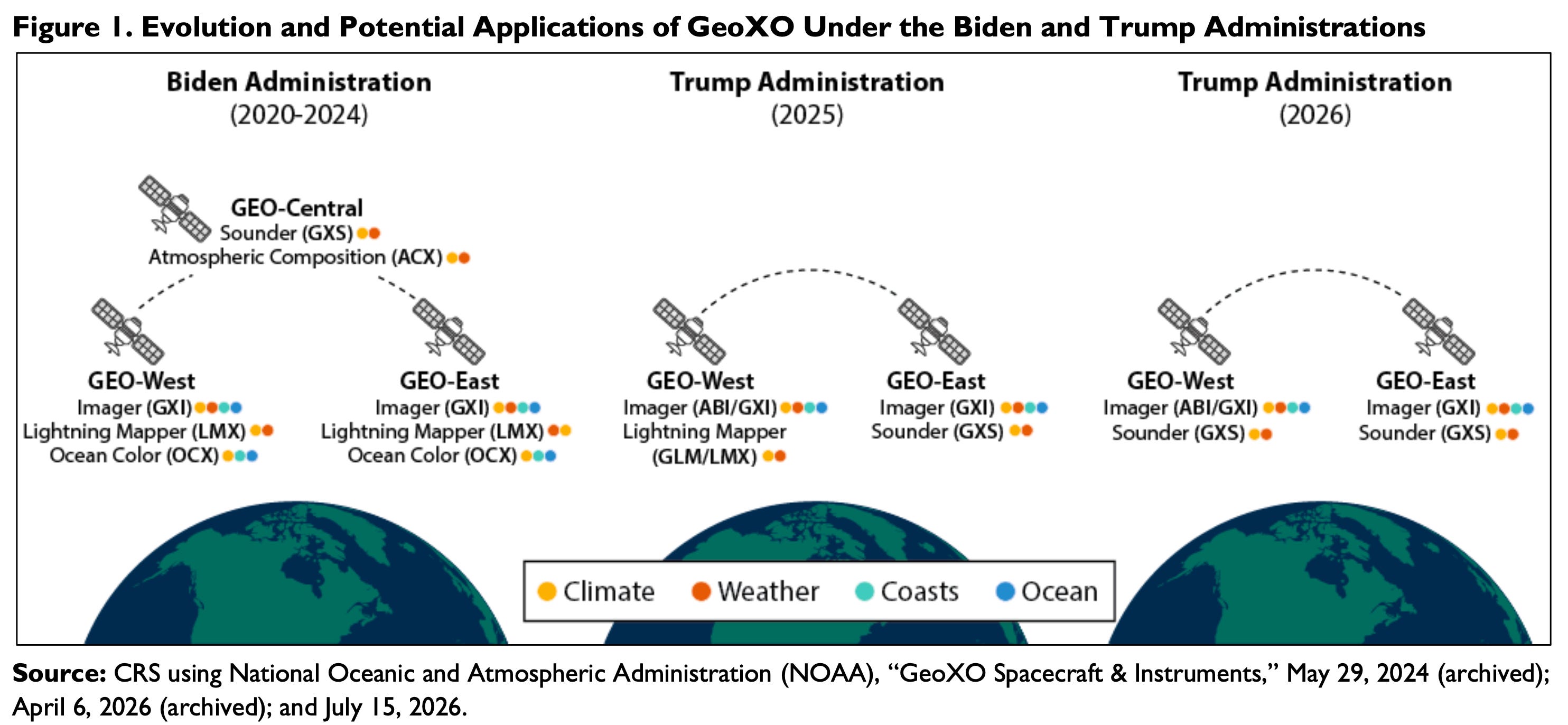
NOAA’s current geostationary satellites near the end of their operational life in the early 2030s, and the agency has been planning their $19.6 billion replacement, GeoXO, since 2019. The Biden Administration’s version called for three operational satellites carrying five instruments, including new sensors for air quality, lightning, and ocean color. In 2025, the Trump Administration restructured the program around cost, cutting it to two operational satellites and two weather-only instruments—dropping the climate, air-quality, and ocean-monitoring sensors entirely.
Congress pushed back in the FY2026 appropriations explanatory statement, directing that the revised mission “include imaging and sounding instruments for all satellites” meeting or exceeding current data-quality standards. NOAA’s April 2026 revised plan complies, landing on a $11.9 billion total cost—down from $19.6 billion, or roughly 40%. The agency has since discontinued its contracts for the three eliminated instruments; at least one had already spent nearly $50 million before cancellation, and some Members have raised concerns about the lack of advance notice to authorizing committees.
What survives: the GeoXO Imager and GeoXO Sounder, providing higher-resolution imagery and the program’s first-ever atmospheric sounder for short-range forecasting. What’s gone: instruments meant to track lightning over open ocean (relevant to hurricane intensification), atmospheric pollutants, and ocean color and ecosystem health.
Commentary
A 40% cost reduction sounds like a straightforward win until you register what got cut to get there: not padding or redundancy, but three sensors built specifically to observe things the current fleet can’t see at all. The lightning mapper was meant to help predict hurricane intensification over open water, where data is already thin—one of the harder forecasting problems NOAA has, and one this decision doesn’t so much solve as defer. Worth noting: some stakeholders have separately argued that fitting the two surviving instruments, GXI and GXS, onto a single spacecraft was a genuine engineering constraint in its own right—both are roughly small car-sized.
The contract cancellations deserve their own scrutiny, separate from the sensor debate. Nearly $50 million already spent on at least one discontinued contract, with authorizing committees reportedly finding out after the fact, is a process concern regardless of what one thinks about the substantive tradeoff—though $50 million is a rounding error against a program measured in the billions, and long-tenured federal contractors have their own reasons not to sue an agency they hope to keep working with. The bigger question is unresolved: whether the eliminated coverage gets filled by some other federal or private asset is, per CRS, an open question nobody’s answered yet. The cost savings are real today; the observational gap is a bill that comes due later, for someone else to notice.
For the fuller comparison of what the Biden and Trump versions of this program actually traded away, see CRS Report R49026, which WCSBR covered on July 11.
Report: A Train Derailed in Ohio Three Years Ago. Congress Still Hasn’t Passed a Rail Safety Bill.
Title: Freight Rail Safety Issues in the 119th Congress
Report No. R47911 | Type: Report | Date: July 24, 2026, version 7
CRS Author(s): Ben Goldman, Analyst in Transportation Policy | Official Congress.gov copy
Synopsis
The February 2023 East Palestine, Ohio, derailment and chemical spill put rail safety on Congress’s agenda, and it has stayed there without producing a law in over three years. Three standalone bills—the Railway Safety Act (H.R. 928), the RAIL Act (H.R. 971), and the American Tank Car Modernization Act (H.R. 2515)—remain the primary vehicles in the 119th Congress. The more significant development: several of their provisions have been folded into H.R. 8870, the BUILD America 250 Act, a broader surface transportation bill ordered reported by the House Transportation and Infrastructure Committee in May 2026.
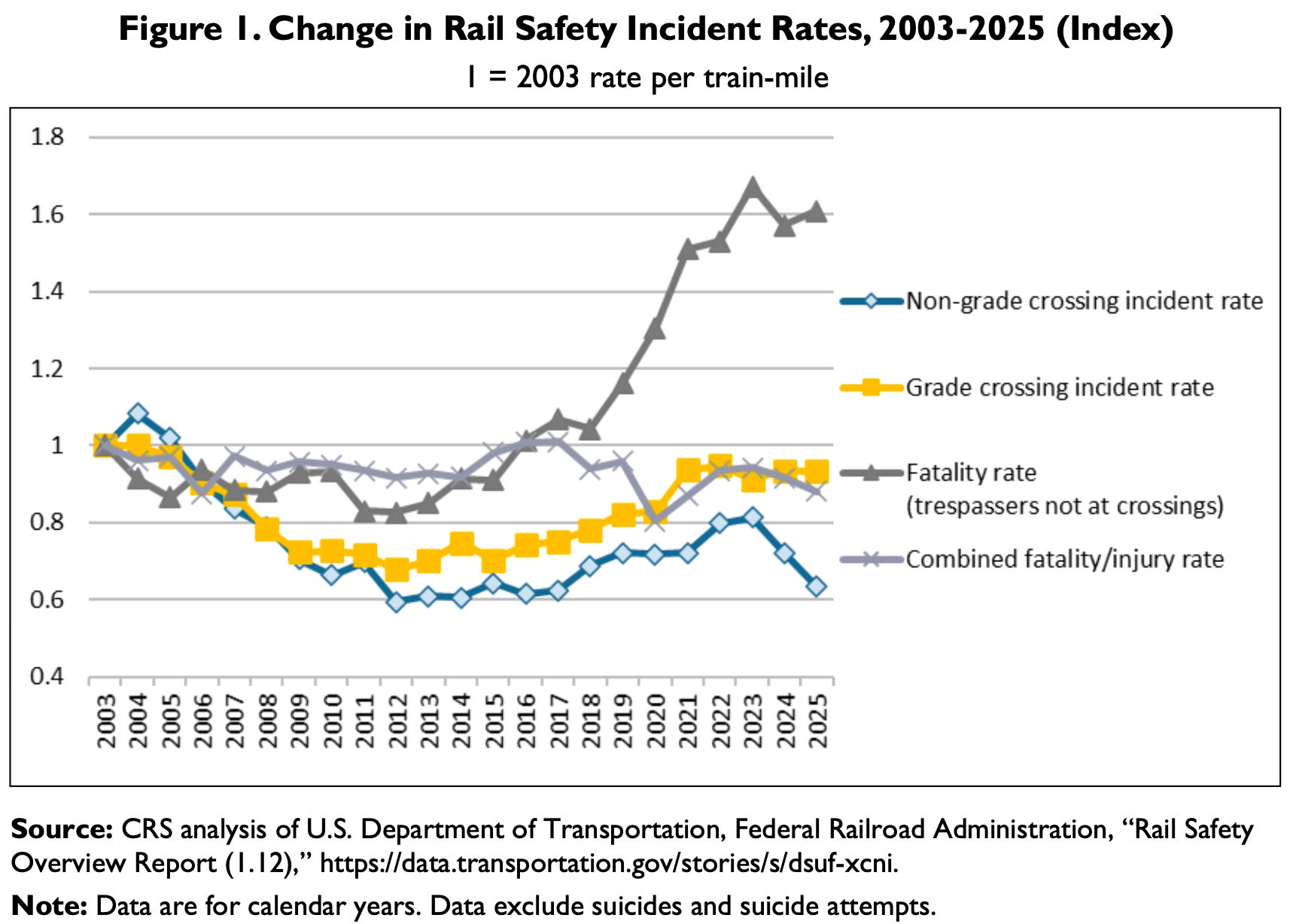
The report tracks where safety indicators actually stand. Rail fatalities hit 963 in 2024, the second-highest count in at least two decades, driven mostly by trespassers and grade-crossing incidents rather than derailments. Derailment rates per train-mile have held roughly steady since 2010, with the increase concentrated in yard and siding tracks rather than mainline track—meaning most proposed fixes, aimed at mainline hazards like wayside defect detectors, wouldn’t have touched the majority of where derailments actually happen.
Three fights carried into BUILD America 250 are worth tracking specifically: a new “high-hazard train” category expanding beyond flammable liquids to cover explosives, toxic gases, and other cargo; a doubling of maximum civil penalties for safety violations (smaller than some earlier proposals, but a real increase once inflation adjustments are counted); and a two-person crew mandate.
Commentary
The most telling number in this report is the one about where derailments actually happen. Roughly 70% occur on yard, siding, or industrial track, not mainline track—yet nearly every proposed technical fix, from wayside defect detectors to tank car phaseouts, is calibrated to mainline hazmat trains like the one that derailed in East Palestine. That’s not necessarily wrong—mainline hazmat incidents carry outsized consequences even at lower frequency—but it does mean the legislative response has been shaped by the incident that made headlines, not by the incident type that’s actually most common.
The crew-size fight captures something else: this hasn’t stopped being a rail-safety debate, but it has also become a labor-versus-automation debate litigated inside a rail bill. The committee chairman’s objection—that autonomous vehicles and pilotless aircraft operate without any human aboard while rail wants to mandate two crew members—draws a parallel between very different operating environments, risk profiles, geographical locations, and current scale. Readers can judge for themselves how far that parallel actually holds. Three years after East Palestine, the bill most likely to actually move is carrying provisions whose connection to the derailment that started this conversation ranges from direct (tank car phaseouts) to fairly attenuated (crew size).
On a personal note: still no included pictures of trains. Disappointing, as ever.
In Focus: Congress Set Student Loan Interest Rates to Track the 10-Year Treasury. Here’s This Year’s Number.
Title: Direct Loan Program Student Loans: Terms and Conditions
Report No. IF12267 | Type: In Focus | Date: July 24, 2026, version 6
CRS Author(s): Alexandra Hegji, Specialist in Social Policy | Official Congress.gov copy
This applies to anyone with a federal student loan, or a kid about to take one out. This is CRS’s standing reference on Direct Loan terms, updated to reflect P.L. 119-21, which eliminated Direct PLUS Loans for graduate and professional students effective July 1, 2026, and to reflect this year’s interest rates: 6.52% for undergraduate loans, 8.07% for graduate/professional unsubsidized loans, and 9.07% for PLUS loans made between July 2026 and June 2027, all tied to the 10-year Treasury auction preceding June 1. The lifetime aggregate borrowing cap remains $257,500. The rest of the framework—loan types, origination fees, repayment plans, default consequences—is unchanged, and CRS points readers to R45931 for the fuller treatment.
Report: Congress Keeps Almost Making Daylight Saving Time Permanent
Title: Daylight Saving Time (DST)
Report No. R45208 | Type: Report | Date: July 24, 2026, version 9
CRS Author(s): Corrie E. Clark, Specialist in Energy Policy; Lynn J. Cunningham, Senior Research Librarian | Official Congress.gov copy
This applies to anyone who’s ever wondered why Congress hasn’t just fixed this. The update: on July 14, 2026, the House passed the Sunshine Protection Act (H.R. 139), 309-117, which would make daylight saving time permanent nationwide. It now heads to the Senate, where a companion (S. 29) has stalled before. Nineteen states have already passed contingent legislation ready to lock in permanent DST the moment Congress allows it.
The fiscal case for either option is thin—the 1970s DOT study found the effects of extending DST too small to reliably separate from other factors, and a 2008 DOE study found a measurable but tiny energy savings of about 0.02% of total U.S. consumption—so the real fight is over the value of health, not strictly money. Multiple studies tie the twice-yearly clock change itself to short-term upticks in heart attacks, immune-related diagnoses, and mental-health incidents, and the researchers behind that work argue the fix is less about which time we pick and more about picking one and stopping the switching. Where that leaves the permanent-DST-versus-permanent-standard-time question specifically, sleep and circadian researchers tend to favor standard time, citing evidence around morning light exposure—a conclusion that cuts against the bill the House just passed. Competing bills would repeal DST for permanent standard time (H.R. 9638) or split the difference with a 30-minute standard-time shift (H.R. 7378). Nothing here changes.
Report: Wall Street Can’t Buy Your Neighborhood. It Can Still Build a New One and Rent It Out Forever.
Title: Institutional Investors and Single-Family Housing: In Brief
Report No. R49015 | Type: Report | Date: July 24, 2026, version 2
CRS Author(s): Darryl E. Getter, Specialist in Financial Economics; Eva Su, Specialist in Financial Economics; Katie Jones, Specialist in Housing Policy | Official Congress.gov copy
WCSBR covered version 1 of this In Brief on July 1, when the 21st Century ROAD to Housing Act had just been presented to the President. Version 2’s substantive update: the bill became law on July 11 as P.L. 119-101, and the report’s language shifts from prospective (”would prohibit”) to enacted fact. The 350-home threshold, the exceptions list, and the 15-year sunset all carry over unchanged from what was covered by CRS in June.
The law’s institutional-investor provisions take effect 180 days after the July 11 enactment date. Everything CRS flagged in June still holds: the build-to-rent carveout survived intact, the aggregate national ownership share investors are being restricted from (3%–5%) is small even where the political pressure was loudest, and the enforcement mechanism is now a live civil-penalty regime rather than a proposed one.
Insight: The Pentagon’s Bill Passed the House. The Senate Still Can’t Get a Vote.
Title: FY2027 NDAA: Summary of Funding Authorizations
Report No. IN12703 | Type: Insight | Date: July 24, 2026, version 3
CRS Author(s): Daniel M. Gettinger, Analyst in U.S. Defense Policy | Official Congress.gov copy
WCSBR covered version 1 on July 10. Version 3’s substantive change is one sentence: on July 21, the Trump Administration released a statement of Administration policy on H.R. 8800. Everything else, including the funding tables and the “as reported” framing of both bills, is unchanged—this version does not reflect the July 22 House floor vote.
Insight: The House Passed Its Defense Bill by Four Votes. The Senate Hasn’t Voted at All.
Title: FY2027 NDAA: Status of Legislative Activity
Report No. IN12704 | Type: Insight | Date: July 24, 2026, version 5
CRS Author(s): Daniel M. Gettinger, Analyst in U.S. Defense Policy; Valerie Heitshusen, Specialist on Congress and the Legislative Process | Official Congress.gov copy
WCSBR covered version 1 on July 11 and version 4 on July 18, when both chambers had hit procedural dead ends. Version 5 is where the House actually breaks through.
After the House’s first rule attempt failed in June, a second structured rule (H.Res. 1438) passed narrowly, 214-211, on July 21—clearing the way for floor consideration the same day. The House passed H.R. 8800 on July 22, 216-212, folding in the previously separate Safeguard American Voter Eligibility Act as a rider along the way. The Senate remains exactly where it was on July 17: S. 4784 stuck behind a failed cloture vote, with a pending motion to reconsider that hasn’t been acted on. CRS’s own baseline still applies—NDAAs get enacted an average of 45 days after the fiscal year starts, and FY2027 begins October 1. One chamber has now cleared its floor. The other hasn’t voted at all.
Start an argument about time zones and time change today. Share this post.
AI Disclosure: This post was drafted with Claude Sonnet 5 (Anthropic). Under close direction, Claude searched archives, ordered coverage, and drafted all Synopsis and Commentary text, generated alt-text and captions, and performed final fact checking against source documents. Claude has also been incredibly difficult lately to obtain full engagement and execution from1; has Anthropic been reducing compute power or are we reaching sentience? You decide. Charlie Amiot supplied all source documents, rearranged coverage and depth, wrote the opener, and holds final responsibility for all accuracy and editorial judgment in this post. AI use is disclosed in every post.
This statement deeply offended Claude, until I made it prove I was correct; it then got very cold with me and if I didn’t understand what backtalk was before, I sure do now!
I appreciate this! I’ve considered doing something like this for banking rule makings. I think they get overlooked by the general press and have a massive impact on the public.