

This is the 100th WCSBR post. Somewhere north of 650 CRS products have come through here since March 31, updates included, missed products excluded. Not bad for under five months. I did not particularly expect to still be doing this, because I wasn’t sure there was an audience for it. The premise of this newsletter is that these documents are easy to overlook and difficult to keep up with, and the thing that makes writing them up worth the hours is knowing there are readers. Thank you.
Today I’m covering the three short products from August 20 and one product for August 21. If anything else shows up dated August 21, I will cover it on Monday or Tuesday, because I’m taking tomorrow/Saturday off. The Freedom 250 Grand Prix and the 2026 National Book Festival are both happening in D.C. tomorrow, and if anything could tempt me to journey into D.C. in August, either event might do it.1 What can I say. I have layers, like an ogre. More likely than not, I’ll stay home coding in the air conditioning, tune in to the NBF programming online on Saturday, and try to figure out what TV antenna channel my local FOX is at to watch the race on Sunday. On the other hand, D.C. food carts…
In Focus: The Bank Approved a Record $10 Billion Loan. Its Charter Expires in December.
Title: Export-Import Bank: Overview and Reauthorization Debate
Report No. IF10017 | Type: In Focus | Date: August 20, 2026, version 43
CRS Author(s): Shayerah I. Akhtar, Specialist in International Trade and Finance | Official Congress.gov copy
Synopsis
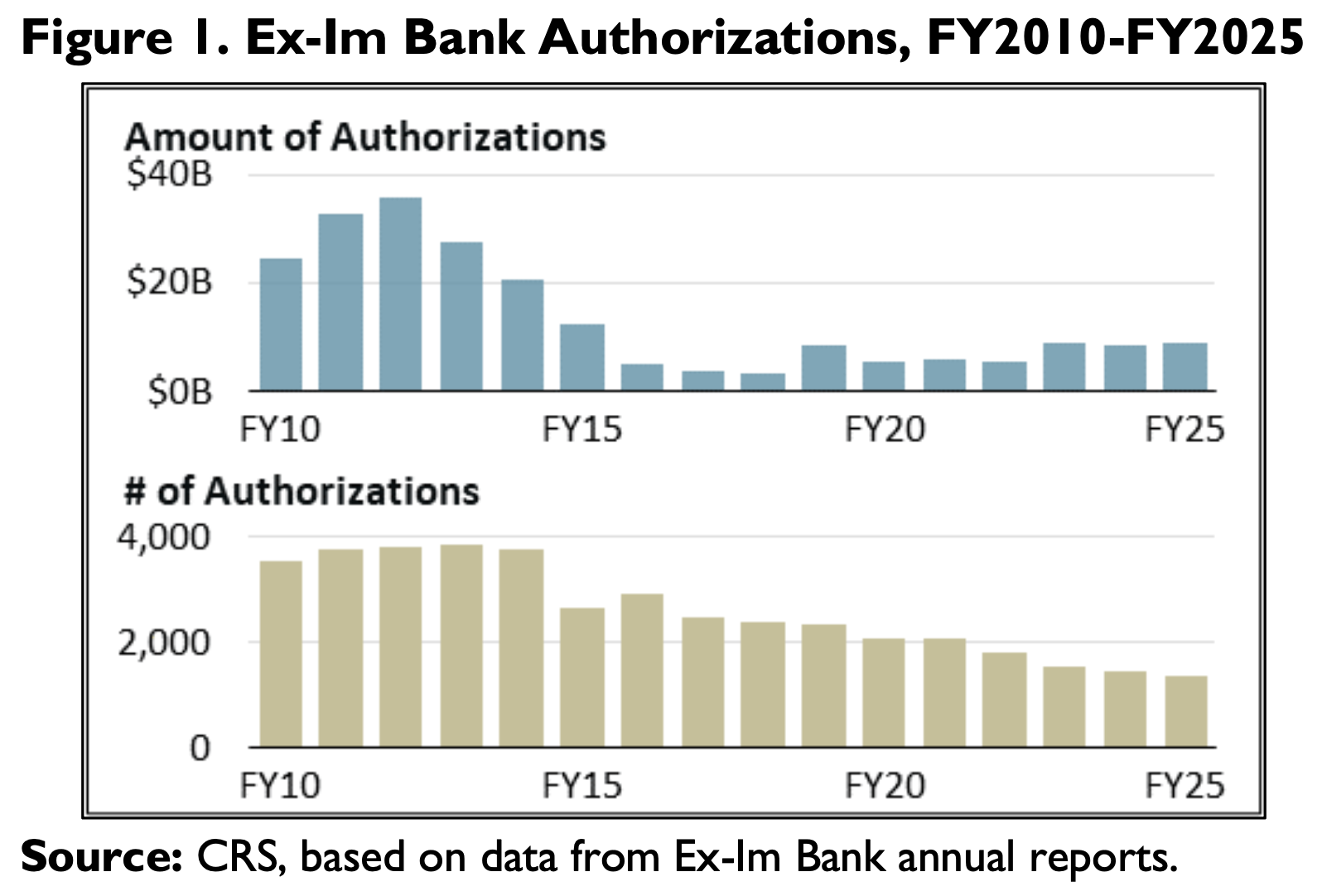
The Export-Import Bank’s charter runs out on December 31, 2026. Congress renewed it in 2019 through P.L. 116-94, and if it lapses the Bank generally cannot approve new transactions—it can service existing obligations and perform certain functions for what the statute calls an orderly liquidation.2 Ex-Im Bank is a wholly owned government corporation and an export credit agency, chartered in 1945, that finances U.S. exports when private lenders will not or when American exporters face foreign state-backed competition. It is governed by a five-member board that currently has three members, exactly the quorum required to approve transactions and set policy. In FY2025 the Bank approved $8.7 billion in transactions, and its default rate stayed well under the statutory cap that would freeze new financing. In February 2026 President Trump announced Project Vault, an Ex-Im-led critical minerals initiative; the Board approved a direct loan of up to a record $10 billion to back it, with another $2 billion expected from private sources. VaultCo LLC, the public-private partnership implementing it, named Brett Lambert executive chairman on July 9, 2026.
Commentary
The Project Vault loan, at up to $10 billion, is larger than everything the Bank approved in FY2025 combined. One initiative exceeds a full year of ordinary operations, at an agency whose authority to conduct ordinary operations expires in roughly four months.
The open questions about Project Vault are the basic ones: which statutory authorities support it, how much due diligence went into the underlying transactions, and how much of its operations Congress and the public will actually be able to see. Those are questions about money the Board has already committed.
Congress has bills, all three sitting in the Senate Banking Committee where they were referred on introduction. S. 3772 would extend the sunset dates by ten years, S. 4781 would raise the exposure cap to $205 billion, and S. 5254 would loosen the default rate cap. What Congress does not have is much calendar.
In Focus: USTR Found China’s Chip Practices Actionable, Then Set the Tariff at Zero
Title: Section 301 and China: Mature-Node Semiconductors
Report No. IF12958 | Type: In Focus | Date: August 20, 2026, version 9
CRS Author(s): Karen M. Sutter, Specialist in Asian Trade and Finance | Official Congress.gov copy
Synopsis
In December 2025, the U.S. Trade Representative determined that Chinese semiconductor policies are actionable under Section 301 of the Trade Act of 1974—and proposed an initial tariff rate of 0% until June 2027 while pursuing a trade deal with Beijing. The investigation, opened in late 2024, examined the People’s Republic of China’s targeting of the semiconductor industry for dominance, focusing on mature-node or legacy chips used in defense, automotive, medical devices, aerospace, communications, and power applications. USTR reports that the PRC government refused to hold consultations. The findings rest on three grounds: extraordinary state control over the industry, nonmarket anticompetitive practices, and efforts to create and exploit foreign dependencies in areas such as critical minerals.
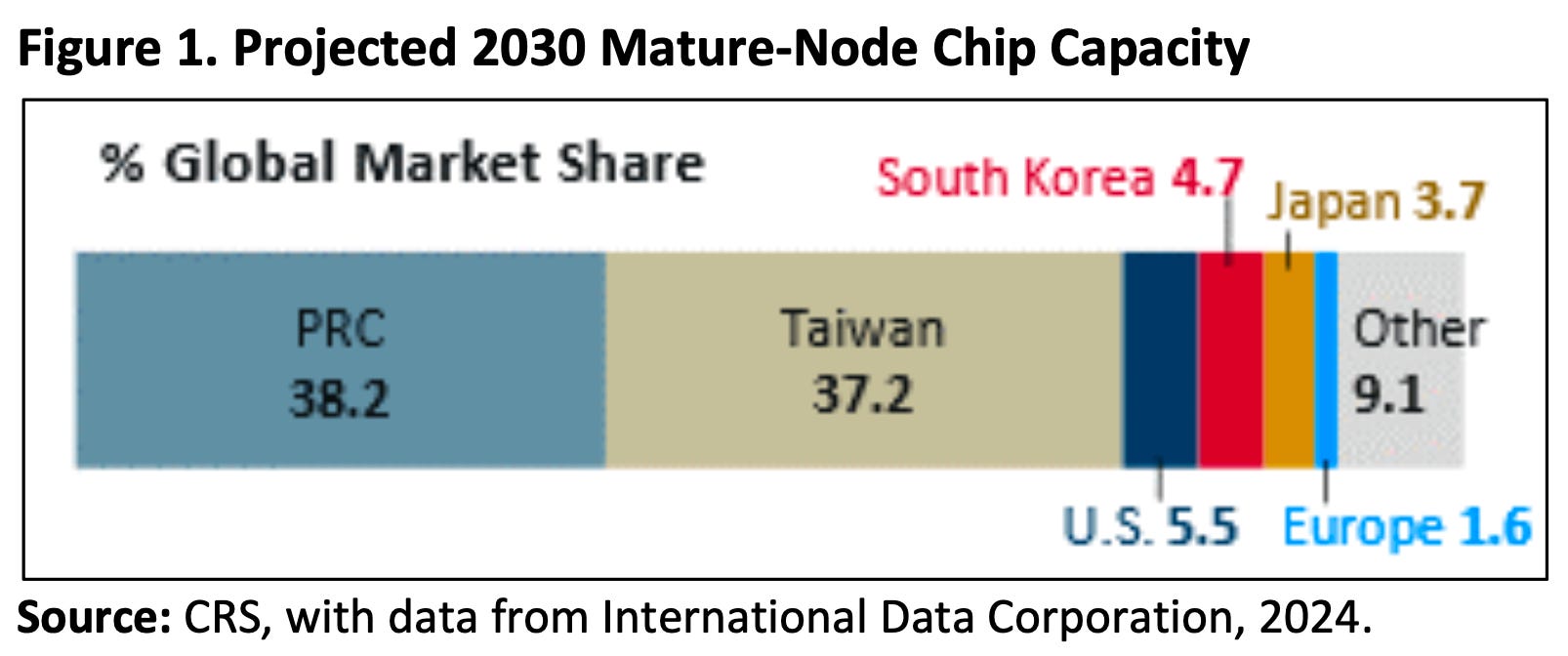
Mature-node chips are generally those at 22 or 28 nanometers and larger—a human hair is roughly 70,000 nanometers across, so the label refers to features something like 2,500 times narrower than that—made on established production processes. They accounted for 88% of global chip sales by volume in 2023 and 40% by value, and roughly 60% of global production capacity sits in mature nodes. China’s share of the 28nm–65nm market rose from 18% in 2020 to 31.5% in 2023, and the firm TrendForce put Chinese output at 34% of global mature-node production in 2024, projected to exceed 38% by 2030.
Commentary
A Section 301 determination is a finding that another country’s conduct is unreasonable and is harming American industry. USTR made that finding and then set the remedy at zero for eighteen months. The finding became leverage in a negotiation rather than a basis for action, which is a legitimate use of the statute and also a choice that leaves the harm running while the talks continue.
Congress’s first option on the table is the obvious one—press USTR to impose the tariffs the finding already supports. The rest of the list is longer and slower: direct the International Trade Commission to study what the delay is costing, extend tariffs to imports with PRC chips embedded in them, or reach for other tools entirely.
The other thing to take from this is which chips are at issue. Not the leading-edge processors that get the headlines and the export controls—the ordinary ones, in cars, medical devices, phone screens, avionics, radar, and even missile guidance.
The conduct USTR is describing is not entirely unrecognizable from this side of the Pacific. Among the practices the finding calls unreasonable is the PRC’s habit of conditioning government benefits on firm concessions—preferences for companies that transfer intellectual property to Chinese entities, pressure on foreign firms to hand over knowhow. Earlier this week WCSBR covered the Second Trump Administration’s approval of Nvidia H200 exports to China on terms giving the U.S. government 25% of the proceeds, which former officials criticized as trading a national security decision for a trade concession. The scale is not comparable and the direction is not the same—nobody is handing American technology to a domestic champion. The structure is: a government-controlled permission, priced.
Insight: The Stablecoin Law Requires Members of Congress to Report Their Own Stablecoin Holdings
Title: Stablecoin Legislation: An Overview of the GENIUS Act of 2025 (P.L. 119-27)
Report No. IN12553 | Type: Insight | Date: August 20, 2026, version 6
CRS Author(s): Paul Tierno, Analyst in Financial Economics | Official Congress.gov copy
Synopsis
This is an overview product. It makes no argument and reaches no conclusion—it lays out what the GENIUS Act, signed July 18, 2025, actually requires, which makes it the fastest way to get oriented in a law now governing a federally sanctioned asset class. Issuers must be approved by a state or federal regulator and must hold a dollar of permitted reserves for every dollar issued, limited to cash, insured deposits, short-dated Treasury bills, repos backed by those bills, government money market funds, and central bank reserves. Issuers must disclose redemption procedures and report reserve composition periodically, with executive certification and examination by registered accounting firms. The act exempts stablecoin issuers from the regulatory capital standards that apply to traditional banks. Nonbank issuers under $10 billion outstanding can opt into a state regime and operate nationally. Payment stablecoins are not securities, not commodities, and not federally insured, though holders receive priority over all other claims against an issuer in bankruptcy. And the act requires the President, the Vice President, Members of Congress, and other federal employees to report stablecoin holdings larger than $5,000.
Commentary
Of note, Congress created a federally sanctioned asset class and, in the same law, required itself and the two most senior officials in the executive branch to report their holdings in it. It is not a prohibition on holding, and it is not a prohibition on issuing, but it is at least a reporting requirement.
Two more things in the text are worth catching. The act bars issuers from paying interest to stablecoin holders, but as noted, holders are not defined and nothing stops an exchange from paying interest to its customers. And an application not acted on within 120 days is deemed approved, which converts regulatory inaction into a license. If only student loan forgiveness worked that way, hmm?
Still open: the enforcement question. The Insight names the reporting requirement and stops there. Whether there is a penalty, who enforces it, and where the report goes are not questions this product answers.
Insight: The Economy Is Growing. Here Are Six Ways That Could Stop.
Title: Six Imbalances Facing the U.S. Economy
Report No. IN12732 | Type: Insight | Date: August 21, 2026, version 1 (New)
CRS Author(s): Marc Labonte, Specialist in Macroeconomic Policy | Official Congress.gov copy
Synopsis
The economy is growing in line with its potential and unemployment is relatively low. This new Insight catalogs what could interrupt that: six macroeconomic imbalances that could threaten the expansion if they correct abruptly rather than gradually, each with its own chart, for anyone who would rather be upset visually. The caveat is stated plainly and it matters—the presence of these imbalances does not make a recession likely, because expansions always carry risk. The starkest figure is federal debt, projected to reach 100% of GDP this year for the first time since World War II, the accumulated product of deficits running above 5% of GDP every year since FY2020. Inflation peaked at 8% in 2022 and still sits above its pre-pandemic range, with the Iran conflict adding energy price volatility. The trade deficit has run unbroken since 1976 and has not closed under the tariffs the President began raising in 2025; research cited here finds those tariffs partially passed through to consumers. AI has lifted productivity, business borrowing, data center investment, and tech stock prices, and brings bubble risk and heavier cyberattack exposure with it. Housing shows rising prices and rents, higher mortgage rates, and less new construction per capita. And the labor supply has shrunk since late 2025, a rare postwar occurrence, driven by an aging population and by immigration policy changes that reduced net migration.
Commentary
Hi, yes, that screaming you just heard was me, learning that the federal debt is projected to reach 100% of GDP this year for the first time since World War II.
These six are not six separate problems. Large deficits push up interest rates and the trade deficit alike, and higher rates are the same rates weighing on the housing section two entries down the list. AI investment is currently contributing to growth, which means the bubble risk and the growth figure are the same object viewed from two angles.
Two of the six carry the fingerprints of decisions made since 2025. Tariffs have not closed the trade deficit and have raised consumer prices. Immigration policy has cut net migration after four years of high inflows, and the shortage lands hardest on the industries most reliant on foreign-born workers.
Congress has tools for all of this, as the Insight says. What it does not have is a version of any of these fixes that costs nothing.
Whatever you choose to do this weekend, stretch, hydrate, and be safe!
AI Disclosure: This post was produced with Anthropic’s Claude Opus 5. Claude ran prior-coverage checks, proposed triage and tier assignments, drafted the metadata blocks, wrote all initial body drafts, wrote the figure alt text and captions, verified the committee status of the three Export-Import Bank bills against congress.gov, and under close supervision performed final factchecking against the source documents. Charlie Amiot supplied the source documents, selected coverage depth and running order, selected all graphics, wrote the opener, footnotes, and recursively revised at the paragraph level throughout. As the human author, Charlie Amiot holds final responsibility for all accuracy and editorial judgment in this post. AI use is disclosed in every post.
Make no mistake, I do have serious concerns about this race’s location and what it may do to the nation’s jewels: the National Archives and other museums enclosed by the raceway or sitting just outside it. President Trump signed an executive order authorizing the race in January, directing the Interior and Transportation Departments to designate the route and issue the permits, as part of the America 250 celebrations. A race can be held in a lot of places. One-of-a-kind treasures can’t be replaced. I am also very grateful not to be a D.C. resident right now, navigating those road closures.
The China and Transformational Exports Program, created in that same 2019 reauthorization, sunsets the same day.