

Not a lot of mental energy to spare tonight, so this one gets a quick opener.
Six products from August 10. The SBA’s inspector general, and the contracting program that two different offices are now auditing at the same time. A legal sidebar on what covers your health apps, since it isn’t HIPAA. Medicare’s hospital trust fund and the 2033 date that didn’t move, which is not the number to watch. Federal child welfare money, nearly all of which arrives after a child has already been removed from home. The Space Force, which would like to more than double its budget. And the labor chapter of USMCA, six years into an enforcement tool that only points one direction.
Report: The SBA Is Auditing Its Own Contracting Program. So Is Its Inspector General. Only One of Them Has to Show Its Work.
Title: SBA’s Office of Inspector General and Its Relationship with Congress: In Brief
Report No. R49123 | Type: Report | Date: August 10, 2026, version 2 (New)
CRS Author(s): R. Corinne Blackford, Analyst in Small Business and Economic Development Policy | Official Congress.gov copy
Synopsis
More than 70 federal agencies have an inspector general. The job is to audit and investigate the agency from inside it, and then tell two audiences what was found: the head of the agency, and Congress. The office is deliberately hard for the agency to control. Its budget is a separate line item rather than a slice of the agency’s. It hires its own staff, picks its own projects, and cannot be blocked from starting an audit or issuing a subpoena. The inspector general can be removed only by the President.
The Small Business Administration’s office had a busy FY2025. It issued 25 audit reports with 123 recommendations. Its investigations produced 234 indictments and informations and 221 convictions, plus 41 suspensions and 27 debarments. It reported $3.76 billion in what it calls dollar accomplishments and $533.3 million in recoveries and avoided losses. As of 2026 it was carrying roughly 500 open investigations.
Most of that workload traces back to one event. SBA’s appropriation is normally around $1 billion a year. In FY2020 it was $762 billion. Working with SBA, the Secret Service, and others, the office says it helped recover more than $30 billion in improper Paycheck Protection Program and pandemic disaster loan payments between FY2020 and FY2025. That work is not close to finished. Pandemic loans stay in SBA’s portfolio for up to 30 years, and Congress extended the fraud statute of limitations to 10 years, so prosecutions can run until at least 2032.
The office is getting smaller while that tail runs out. Its base appropriation has not changed since FY2024. Staffing peaked at 211 full-time equivalents in FY2024; the FY2027 request is 154. Leadership was also vacant for roughly a year: Inspector General Hannibal Ware was removed in January 2025, among several inspectors general dismissed following the second Trump Administration’s inauguration, and William Kirk was not sworn in until January 6, 2026.
Two audits of the same program are now running in parallel. SBA Administrator Loeffler ordered a full-scale audit of the 8(a) Business Development Program in June 2025, ordered all participants to hand over financial records in December, and suspended more than 1,000 firms in January 2026 for not producing them. Separately, the inspector general has planned 2026 audit work on how SBA certifies 8(a) eligibility in the first place and how it oversees entity-owned firms in the program.
Commentary
The independence protections in the Inspector General Act are all about interference. They stop an agency from firing the auditor, redirecting the auditor, or shutting down an inquiry midstream. None of them addresses the simplest way to reduce oversight, which is to fund less of it. The FY2027 request would put the office at 154 staff, 27% below its FY2024 peak, at a point when pandemic fraud remains prosecutable until 2032 and the loans stay on the books for decades.
The 8(a) situation is the sharper illustration. The inspector general’s audit has to follow government auditing standards and end in findings reported to the administrator and to Congress. The agency’s own review has no published methodology and no stated plan for disclosing what it finds, and it has already suspended more than a thousand firms. Two reviews of one program, and the one bound by procedure is the smaller of the two.
The office costs about $38.6 million a year to run. The improper pandemic payments it helped recover between FY2020 and FY2025 come to more than $30 billion. Even crediting most of that to the agencies it worked alongside, this is not a line item anyone trims on efficiency grounds.
Legal Sidebar: Your Health App Probably Isn’t Covered by HIPAA. Here’s What Is Covering It Instead.
Title: Artificial Intelligence in Health: Overview of Selected State Liability Frameworks
Report No. LSB11467 | Type: Legal Sidebar | Date: August 10, 2026, version 2 (New)
CRS Author(s): Wen W. Shen, Legislative Attorney; Jennifer A. Staman, Legislative Attorney | Official Congress.gov copy
Synopsis
Most people assume health privacy in this country means HIPAA. HIPAA’s privacy rule reaches a specific list: health plans, health care providers who bill electronically, health care clearinghouses, and the companies that work for them. A period-tracking app, a wearable that estimates your heart rate variability, or a chatbot you ask about a symptom is generally none of those things. So when someone believes an AI health product has hurt them, they sue under something else. This sidebar is a map of the something else.
The suits fall into two groups. The first involves insurers using AI to decide whether to pay a claim. In one case, plan participants allege an algorithm let physician reviewers deny claims in batches without meaningful review. In two others, Medicare Advantage enrollees allege their plans used an unreliable AI model instead of physicians to decide coverage for post-acute care. All of them lean on state consumer protection statutes, the unfair-and-deceptive-practices laws every state has, many of which let a harmed consumer sue directly.
Whether those claims survive depends on which kind of insurance the plaintiff happened to have. Two district courts held that Medicare’s preemption provision wiped out the state consumer protection claims against Medicare Advantage plans, though ordinary breach of contract claims survived. A different court held that ERISA, which governs employer-sponsored coverage and contains a savings clause, did not preempt the same kind of claim. Same alleged conduct, opposite result.
The second group involves consumer products: a menstrual tracking app, a facial-scan skin assessment tool, a fitness wearable, a temperature screening kiosk with facial recognition, and a general-purpose chatbot that interacts with users as fictional characters. Most of these allege privacy violations under state law. Illinois’s biometric privacy act, which covers biometric identifiers including scans of face or hand geometry and gives individuals a right to sue, has carried claims past dismissal in at least two of them. California’s medical confidentiality law, which reaches software designed to hold medical information, is doing the work in the wearable and period-tracker cases.
The chatbot suits are different, and they are the ones to watch. Plaintiffs allege the product was defectively designed in a way that makes it unsafe for the young people using it, and that users were not warned. That is products liability, a body of law courts have historically reserved for tangible things. Software has usually been treated as either a service or pure expression, the latter raising First Amendment problems. In Garcia v. Character Technologies, Inc., a district court held that an AI chatbot can be a product for liability purposes to the extent the claimed defects are design features, such as the absence of age verification and reporting mechanisms, while dismissing the parts of the claim resting on what the chatbot actually said. The court also allowed claims against Google as the maker of a component part, on the theory that its large language model was integrated into the chatbot.
Above all of this sits an unsettled federal picture. FDA has been approving AI-enabled medical devices since 1995 but describes the current landscape as a spectrum running from products it does not regulate to products it does, and acknowledges the spectrum confuses people. Its updated guidance on general wellness wearables does not address AI. Meanwhile, states have started legislating directly, imposing limits on AI in mental health care and coverage decisions and requiring companion chatbot operators to maintain protocols for users expressing self-harm. The second Trump Administration has directed the Attorney General to establish an AI Litigation Task Force, created in January 2026, to challenge state AI laws that conflict with a national policy Congress has not yet written. Two bills, the Youth AI Privacy Act (S. 4199) and the Senior Chatbot Protection Act of 2026 (S. 5117), would regulate general-purpose chatbots while preserving stronger state protections.
Commentary
Read the list of laws being used here and the pattern is hard to miss. A biometric statute written for face and fingerprint scans. A medical confidentiality law written for records. Consumer protection statutes modeled on a federal law about unfair and deceptive business practices. Products liability doctrine built for objects you can drop on your foot. Not one of them was written with any of this in mind, and courts are now deciding, case by case, how far each one stretches.
The preemption results make the point sharpest. Two people can be denied the same nursing home stay by the same kind of model on the same day, and only one of them can bring a consumer protection claim over it. The difference is not the conduct, the harm, or the state they live in. It is whether their coverage came from Medicare Advantage or from an employer. Nobody designed that. It fell out of two statutes written decades apart for unrelated reasons, and it is now the thing that decides who gets a remedy.
Which leaves the state laws, and they are the only ones in the country written specifically for these products. Congress has not passed a national standard. The second Trump Administration has nonetheless stood up a litigation task force to challenge state AI laws for conflicting with a national policy that does not exist yet. CRS cannot say whether the health-specific ones are on its list. So the question of which protections survive is being answered by a task force and a docket, and not by anyone who had to run for the job.
Report: Medicare’s Hospital Fund Runs Out in 2033. Nobody Has Written Down What Happens Next.
Title: Medicare: Insolvency Projections
Report No. RS20946 | Type: Report | Date: August 10, 2026, version 31
CRS Author(s): Thomas P. Hackman, Analyst in Health Policy | Official Congress.gov copy
![A line chart titled “HI Trust Fund Assets at Beginning ofYear [sic] as a Percentage of Annual Expenditures,” covering 2006 through 2036 on the horizontal axis and 0% to 160% on the vertical axis. Seven forecast lines, drawn from the 2009, 2012, 2015, 2018, 2021, 2024, and 2025 Medicare trustees reports, each start high and descend to 0%, with each successive report’s line reaching zero later than the one before it. A separate brown line labeled “Actuals” tracks the fund’s real balance, falling from about 150% in 2006 to roughly 40% to 60% in recent years.](https://substackcdn.com/image/fetch/$s_!cYrK!,f_auto,q_auto:good,fl_progressive:steep/https%3A%2F%2Fsubstack-post-media.s3.amazonaws.com%2Fpublic%2Fimages%2F767aa1d3-f24d-4772-8fd0-4072c74ab41d_2678x1852.png "A line chart titled “HI Trust Fund Assets at Beginning ofYear [sic] as a Percentage of Annual Expenditures,” covering 2006 through 2036 on the horizontal axis and 0% to 160% on the vertical axis. Seven forecast lines, drawn from the 2009, 2012, 2015, 2018, 2021, 2024, and 2025 Medicare trustees reports, each start high and descend to 0%, with each successive report’s line reaching zero later than the one before it. A separate brown line labeled “Actuals” tracks the fund’s real balance, falling from about 150% in 2006 to roughly 40% to 60% in recent years.")
Synopsis
Medicare’s trustees released their 2026 report, and the headline number did not move. The Hospital Insurance trust fund, which pays for Part A, is projected to run out of money in the second quarter of 2033, the same year the 2025 report gave.
Part A is the hospital side of Medicare: inpatient stays, skilled nursing, home health, hospice. In 2026 it will spend about $481 billion of Medicare’s roughly $1.33 trillion total, covering about 70.7 million people. It is funded almost entirely by the 1.45% payroll tax each worker and employer pays, with no cap on earnings, plus a smaller stream from income taxes on Social Security benefits. Money in, benefits out, in the same year.
Insolvency here does not mean Medicare stops. Payroll taxes keep arriving. They would just cover about 89% of Part A’s bills. The problem is that nothing in law says what to do about the other 11%. The Social Security Act has no provision for it, Part A has no authority to draw on general revenue, and agencies cannot move money between accounts without permission from Congress. The trustees expect payments to plans and providers would be delayed first, and warn that access to Part A services could deteriorate quickly after that. CMS would have two options, both untested: pay everything late, with the delay growing each period, or pay on time at reduced rates.
The 2033 date held steady for a specific reason. Medicare Advantage enrollment and spending came in higher than expected, and lower Part A spending in the 2025 base year mostly canceled it out. But the longer-term gap widened. To keep the fund solvent for 75 years, the trustees estimate the payroll tax would have to rise immediately by 0.56 percentage points, or benefits would have to fall by 12%. That tax figure is 0.16 percentage points higher than last year’s, driven by higher 2025 spending, reduced taxation of Social Security benefits under the 2025 reconciliation law (P.L. 119-21), and projections of lower fertility and immigration, which mean fewer future workers paying in.
The near-term arithmetic is simple. 2026 is the last surplus year, at $6.2 billion. 2027 begins a run of deficits. The fund’s balance is projected to fall from $261.9 billion at the end of 2026 to zero during 2033, and to keep going: $56.9 billion in the red that year, $296.5 billion by 2035.
Part B and Part D cannot become insolvent, because their funding adjusts automatically each year to cover projected costs. That is not as reassuring as it sounds. Care has been shifting steadily out of hospitals and into outpatient settings, which moves spending from the payroll-tax side of Medicare to the side funded by beneficiary premiums and general revenue. The trustees project the share of federal income tax revenue needed for Parts B and D will rise from about 17.6% in 2025 to 28.6% in 2040.
Commentary
The insolvency date is the number everyone reports, and it is the least informative one in the document. It did not move, and the hole underneath it got bigger. Last year’s report said an immediate 0.40-point payroll tax increase would close the 75-year gap. This year’s says 0.56. That is a meaningful deterioration hiding behind a headline that reads as stability.
Some of the deterioration was a decision. The 2025 reconciliation law reduced taxation of Social Security benefits, and a portion of that revenue had been flowing into the hospital trust fund since 1994. It is one of three factors the trustees name, and it was not large enough to move the insolvency date, but it made the long-run gap wider. Congress passed it the same year the trustees moved the insolvency date three years closer.
The figure above is the real story. The trustees have been projecting this fund’s exhaustion since 1970, and it has never once happened. Sometimes Congress moved the date, as with the 1997 balanced budget law and the ACA. More often the economy moved it. There is no statutory plan for insolvency because there has never needed to be one. That is not a safety mechanism. It is a habit, and it is currently the whole plan.
In Focus: The Federal Government Spends $10 Billion on Children Already Removed From Their Homes and $203 Million on Keeping Families Together
Title: Child Welfare: Purposes, Federal Programs, and Funding
Report No. IF10590 | Type: In Focus | Date: August 10, 2026, version 58
CRS Author(s): Emilie Stoltzfus, Specialist in Social Policy | Official Congress.gov copy
Synopsis
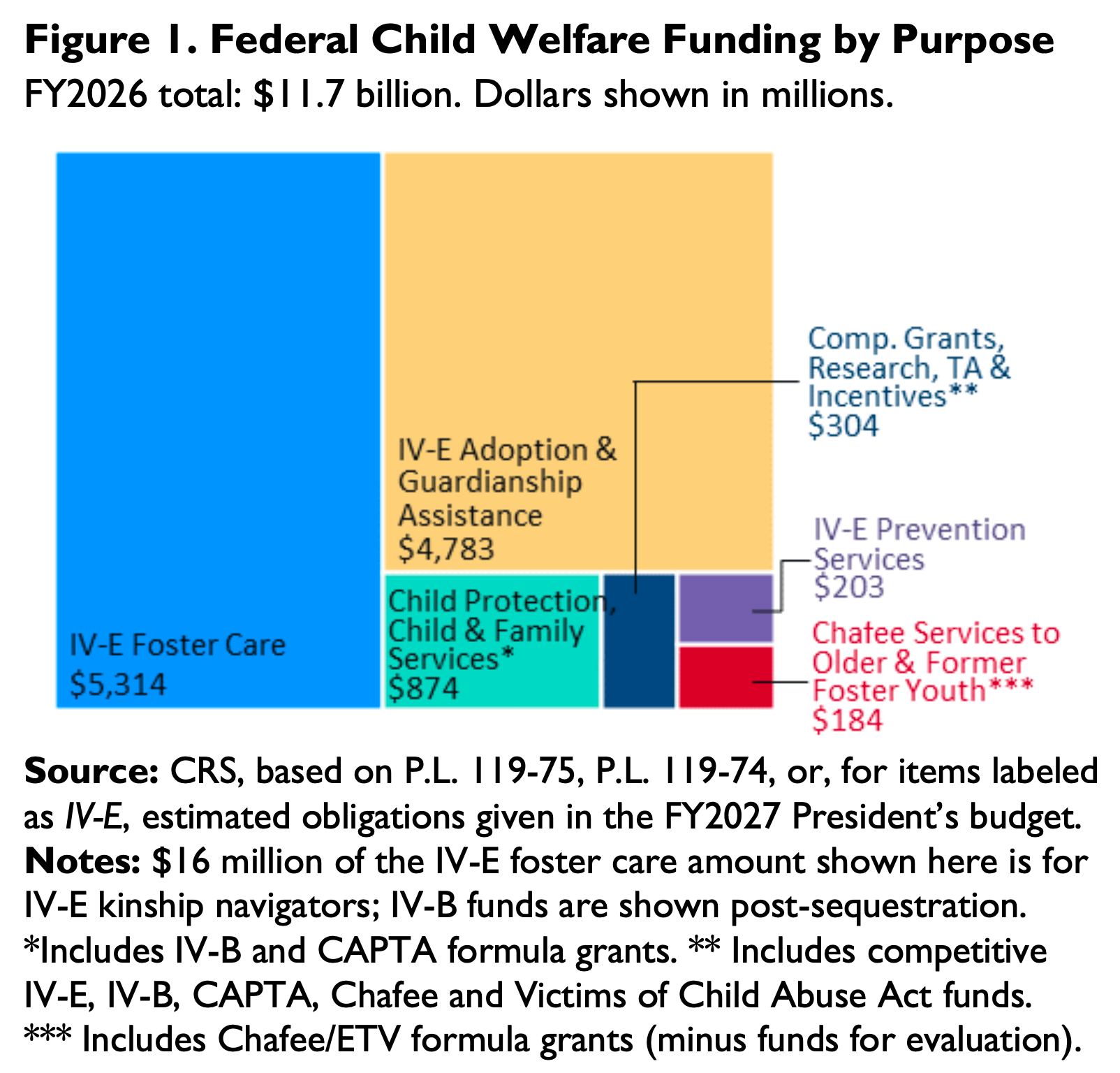
Congress finished FY2026 child welfare funding on February 3, 2026, in P.L. 119-75. The federal total is $11.7 billion. Where that money goes is most of the story of how the system works.
Roughly 175,000 children entered foster care during FY2025. More than 331,700 were in care on September 30, 2025, and 78% of them were living in someone’s home rather than a group facility. About 169,900 left care that year: a little over half went back to a parent or to a relative, 36% were adopted or placed with a legal guardian, and 9% aged out at 18 or older with no permanent family. The circumstances recorded at entry are worth reading plainly. Neglect appears in 55% of entries, a caretaker’s drug use in 29%, physical abuse in 13%, and inadequate housing in 10%. Most children have more than one.
Child welfare is primarily a state responsibility. States and localities covered more than half of the $34.3 billion spent nationally in state FY2022, though the state share ranged from 20% to 83% depending on where you look. The federal government adds rules and money on top. Most of the federal money moves through Title IV-E of the Social Security Act, which reimburses part of the cost of foster care and adoption assistance for children who meet federal eligibility tests. Those tests are narrow enough that in an average month of FY2024, only one in three children in foster care had a federal IV-E foster care payment behind them.
Tribes run child welfare programs too, and federal rules treat a participating tribe as its own agency rather than as part of a state. A tribe with an approved plan claims Title IV-E foster care and adoption assistance on the same 50%-to-83% cost-sharing terms a state does, receives Title IV-B formula money on the same $3-federal-to-$1-local match, and can run its own prevention program. Uptake is early. Five tribes had approved IV-E prevention plans as of April 2026, and one tribe is approved to claim kinship navigator funds.
A much smaller piece of IV-E pays for prevention, meaning services offered to families where a removal looks likely, so that it does not happen. That money first became available in FY2020. Five IV-E agencies claimed it that year and served fewer than 1,000 children. By FY2024, 31 agencies claimed it and served more than 22,800. A related program funds kinship navigators, which help grandparents and other relatives raising a child find the support they need; three states claimed that money in FY2024, reaching 900 families.
Commentary
Add the two largest blocks in Figure 1 together and about 87 cents of every federal child welfare dollar is going to children who have already been removed from home. Prevention gets under two cents.
That gap is not a spending cap. Title IV-E is open-ended, meaning there is no ceiling on what the federal government will pay once a child is in foster care or has been adopted out of it. The limit on prevention is procedural. A state has to get a prevention plan approved, pay half the cost itself, use services that clear a federal evidence standard, and spend at least half of its prevention money on services the government has rated well-supported. Six years in, three states still have no approved plan, one of them with a plan under review.
Congress appears to have noticed. Beginning in FY2027, the federal match for IV-E prevention services rises from a flat 50% to the same 50%-to-83% range that foster care already gets. Asking states to fund prevention at half price while funding removal at up to 83% produced the result anyone would expect. Congress wrote that split, watched it work exactly as designed for six years, and set the correction to begin in FY2027.
In Focus: The Space Force Wants to More Than Double Its Budget. Congress Is Busy Arguing About One Satellite Program.
Title: Defense Primer: U.S. Space Force
Report No. IF12610 | Type: In Focus | Date: August 10, 2026, version 8
CRS Author(s): Jennifer DiMascio, Analyst in U.S. Defense Policy; Hannah D. Dennis, Analyst in U.S. Defense Policy | Official Congress.gov copy
WCSBR covered version 6 on April 17, when the story was the FY2027 budget request. Much has changed. The service has a new commander, a rebuilt acquisition structure, a published vision for 2040, and an end-strength request that did not exist in April.
The Space Force has a new commander. In August 2026 the Senate confirmed Lieutenant General Douglas Schiess to replace General B. Chance Saltzman as Chief of Space Operations, the service’s senior uniformed officer. Between January and July 2026 the service also rebuilt how it buys things, consolidating program offices under nine Portfolio Acquisition Executives in line with the Pentagon’s Acquisition Transformation Strategy. In April it published two planning documents, Future Operating Environment 2040 and Objective Force 2040, which describe a future in which the threshold for attacking something in orbit, by weapon or by interference, is lower than it is today. The service intends to publish a new Objective Force every five years.
The FY2027 request is $71.3 billion. That is $59.2 billion in regular appropriations plus $12.1 billion the service anticipates receiving through an FY2027 reconciliation bill that has not been written. Together it is 123% more than what the Space Force actually received for FY2026. Of the discretionary request, $38.4 billion (65%) is research and development rather than equipment being purchased. The request assumes 13,200 uniformed personnel, 2,800 more (27%) than FY2026 authorized, and both the House-passed FY2027 NDAA and the Senate Armed Services Committee’s version would authorize the increase (H.R. 8800, §401; S. 4784, §401). Officials have separately said the workforce could double over the next decade.
The more interesting material is where Congress is pushing back. The Air Force’s FY2027 budget proposed terminating OPIR Polar, the polar-orbit portion of the next-generation satellite system that watches for missile launches. Congress had already prohibited pausing, canceling, or terminating any OPIR program in the FY2026 appropriations act (P.L. 119-75, §8149). The House-passed FY2027 NDAA would direct the department to keep executing it (H.R. 8800, §1606), the Senate bill would authorize $500 million for it, and House appropriators would provide $200 million. Separately, the House bill would block full-rate production of space-based interceptors for Golden Dome until the Pentagon delivers an independent cost assessment and certifies a successful flight test (H.R. 8800, §1655); the second Trump Administration opposes the provision on the ground that it would delay delivery. Some Members have also pressed for more competition in space launch and satellite communications and raised concerns about sole-source contracting.
One number in the RDT&E Programs (R-1) does not appear in this product. The Space Force’s FY2027 budget justification carries a single line called Classified Programs under Operational System Development, at $17.33 billion. Measured against the service’s full research and development request of $40.66 billion, that one line is more than 42% of everything the Space Force wants to spend on R&D, and the largest single line in the request.1 Congress is fighting in public over $500 million for a polar missile-warning satellite. The single biggest research line in the service’s budget has no public description at all.
In Focus: The United States Has Used Its Factory-Level Labor Enforcement Tool About 40 Times. Mexico Has Never Used It Once.
Title: USMCA: Labor Provisions
Report No. IF11308 | Type: In Focus | Date: August 10, 2026, version 11
CRS Author(s): Cathleen D. Cimino-Isaacs, Specialist in International Trade and Finance; Danielle M. Trachtenberg, Analyst in International Trade and Finance | Official Congress.gov copy
The U.S.-Mexico-Canada Agreement replaced NAFTA in 2020. Inside it is something no previous U.S. trade agreement had: a way to go after a single factory. The rapid response mechanism lets one government act against a specific worksite in the other country if it believes workers there are being denied the right to organize and bargain collectively. An adverse finding can mean tariffs on that facility’s goods, and for repeat offenders, blocking its imports. USTR has invoked it in roughly 40 cases involving facilities in Mexico, across autos, garments, mining, food manufacturing, and services. Most ended in a remediation plan or were resolved during the initial review; six reached a panel. Mexico has never invoked it against an American facility. Between the United States and Canada, no such mechanism exists at all. USMCA was also the first U.S. trade agreement to commit its parties to prohibit imports made with forced labor, mirroring a U.S. import ban on the books since 1930.2
Part of that asymmetry is built into the text. To bring a case against a U.S. facility, Mexico needs an enforced order from the National Labor Relations Board first, and some experts argue that condition makes the mechanism close to unusable in that direction. In 2019, when a group of House members and the first Trump Administration renegotiated these provisions, some Members described the conditions as important safeguards. The implementing law also put money behind enforcement: $180 million over four years to the Labor Department’s international bureau to support Mexico’s labor reforms, and $30 million over eight years to monitor compliance, including labor attachés posted in Mexico. The second Trump Administration has reduced that bureau’s funding and terminated technical assistance projects, including in Mexico, though in 2026 the bureau announced a $23 million award for labor law enforcement there.
All of this now sits inside a renewal fight. In July 2026, at the first joint review of the agreement, the United States declined to renew USMCA in its current form for another 16-year term. Mexico and Canada supported renewal. The agreement remains in effect through 2036 but is now subject to annual review until it is renewed or expires. In June 2026, a USTR investigation determined that both Mexico and Canada had failed to effectively enforce their own bans on forced-labor imports, and USTR imposed a 10% tariff; both countries are contesting the finding. USTR Jamieson Greer has said U.S. priorities for the review may include better labor law enforcement in Mexico.
To be precise about what this tool can reach: a covered facility has to sit in a priority sector, meaning manufactured goods, services, or mining, and has to produce goods or supply services that are traded between the countries or that compete in the other country’s market. Agriculture is not covered at all. In practice that describes an export factory. It does not describe the Starbucks stores and Apple retail locations where visible American union campaigns of the past several years have actually happened. Those are services sold to the person standing at the counter; they are not traded across a border and they do not compete in Mexico’s market. Add the requirement that any claim against a U.S. facility rest on an enforced National Labor Relations Board order, and the mechanism is aimed, by construction, outward.
The labor chapter was an unusual thing for a trade agreement to contain: an enforceable promise about how another country treats its own workers, with a tool sharp enough to reach one building. Six years on, the tool runs almost entirely in one direction, and the country holding it has declined to commit to another sixteen years.
Share this with anyone who thinks “insolvent” means “bankrupt.”
It means 89%. For now.
AI Disclosure: This post was produced with Claude Sonnet and Opus 5, by Anthropic. Claude verified archive integrity, ran prior-coverage checks, proposed the triage tiers, under direction wrote initial drafts, and authored the metadata block, alt text, and captions. Charlie Amiot supplied the source documents, set the tier assignments and running order, personally ran the version comparison for IF12610, and revised the article throughout. Of particular focus this week is tone and coverage. Claude flagged one citation error in the CRS source, footnoted at the end of the USMCA entry. Charlie Amiot is solely responsible for all accuracy and editorial judgment here. AI use is disclosed in every post.
The $40.66 billion R-1 figure is the Space Force's full RDT&E request, discretionary and mandatory combined. The $38.4 billion cited above is CRS's discretionary-only figure.
The report cites this as Section 307 of the Trade Act of 1930. The provision is Section 307 of the Tariff Act of 1930 (19 U.S.C. §1307). The substance is unaffected.